
The head of Alliant Energy’s Wisconsin energy company urged county government leaders to “be careful you understand what you’re saying no to” amid the public backlash to data center development in the state.
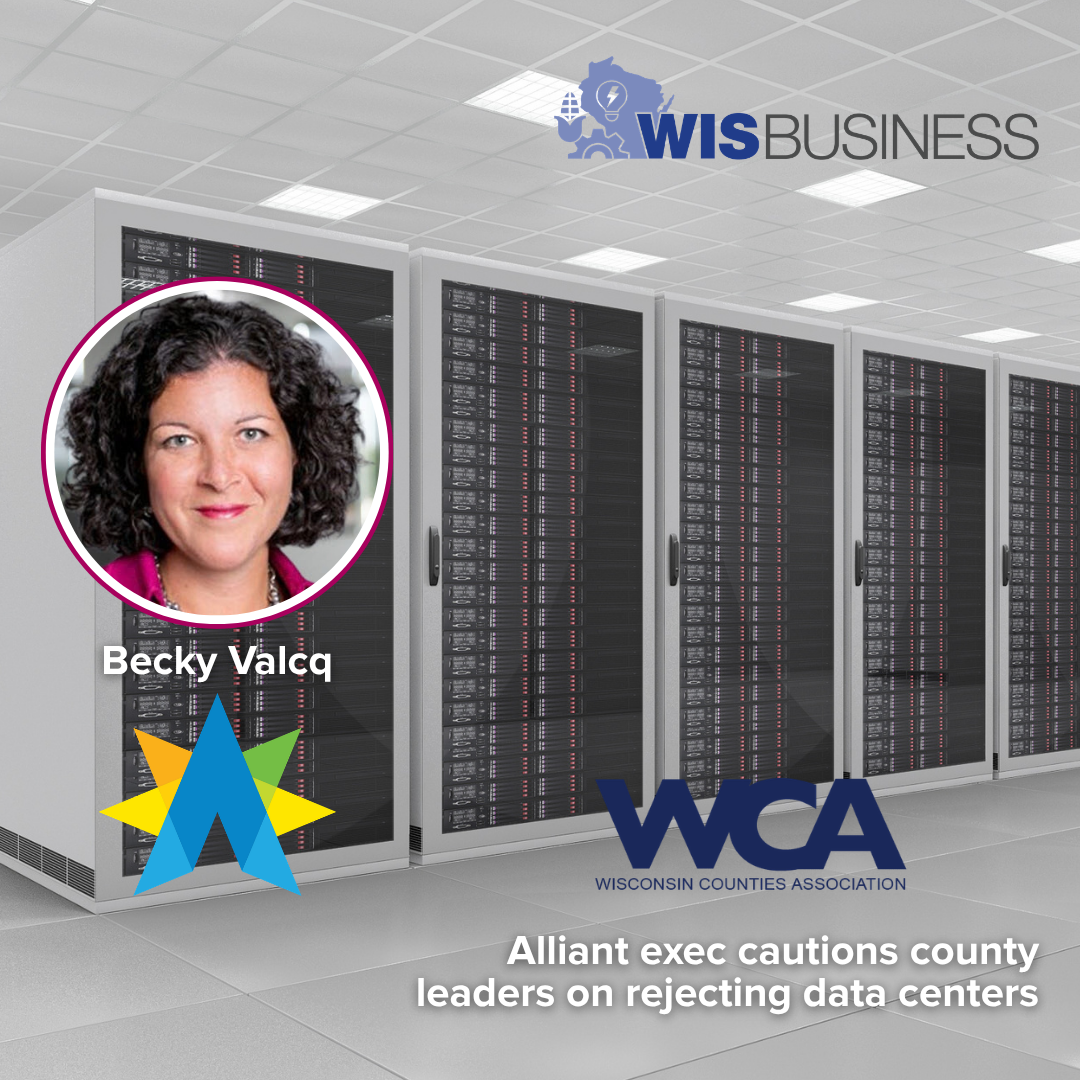
Becky Valcq, the utility’s vice president of energy delivery and a former chair of the state Public Service Commission, yesterday addressed members of the Wisconsin Counties Association during the group’s annual conference.
Even as many local governments in the state hit pause on new data centers through moratoriums and residents voice concerns about the massive projects driving up energy costs and impacting natural resources, Valcq argued the data center wave is both inevitable and a boon for Wisconsin’s energy infrastructure.
“They’re already here,” she said. “They’re going to continue to come. The question then turns to, how do we make sure that their arrival benefits Wisconsin residents the most. That’s the way we should be looking at it.”
She said Alliant Energy will take an aggressive approach to pursuing “all types” of customers.
“We want them. We want them here yesterday, because we want to see growth,” Valcq said.
While Valcq said she’s not speaking in defense of any energy customers in particular, she went on to say the large load customers paying for new infrastructure such as substations benefits “everybody” as well as the energy grid itself.
“The grid is becoming harder, it’s becoming more resilient, but that cost is being picked up by the large load customer,” she said. “That’s why, for us at Alliant Energy, we view it as a potential gamechanger.”
She noted major tech companies behind these projects are currently racing one another, but added “at some point that race is going to end” and they’ll be done building data centers. But for now, these businesses are focused on where they can secure the power they need for these projects as fast as possible.
Valcq reiterated Alliant’s commitment to forcing large load customers to pay for all the new infrastructure needed to deliver their power.
She referenced the utility’s agreement with Meta, which is building a $1 billion AI data center in Beaver Dam, noting the social media site operator will be paying Alliant more than what it costs to serve the business following rate negotiations.
“To the extent that Alliant can bring in revenues in excess of our costs, those revenues go back into our system,” she said. “They go back to help us decrease the number of rate increases that we seek from the commission.”
She also mentioned concerns being voiced about data center impacts on renewable energy development, given that some utilities are advancing natural gas projects to meet higher expected energy demand linked to these projects. Instead, Valcq argued many “hyperscalers” are interested in forming agreements with locals that actually offset their energy consumption, pointing to negotiations between developer QTS and DeForest.
While the company’s plans for a data center ultimately fell through, it had initially discussed the possibility of building enough solar energy installations in DeForest to offset all residents’ energy consumption, according to Valcq. She noted the company is now looking at potential sites in Iowa.
“It’s an opportunity to utilize a customer that has vast resources, to be able to pay for infrastructure improvements that ultimately, everybody on our system stands to benefit from,” she said.