
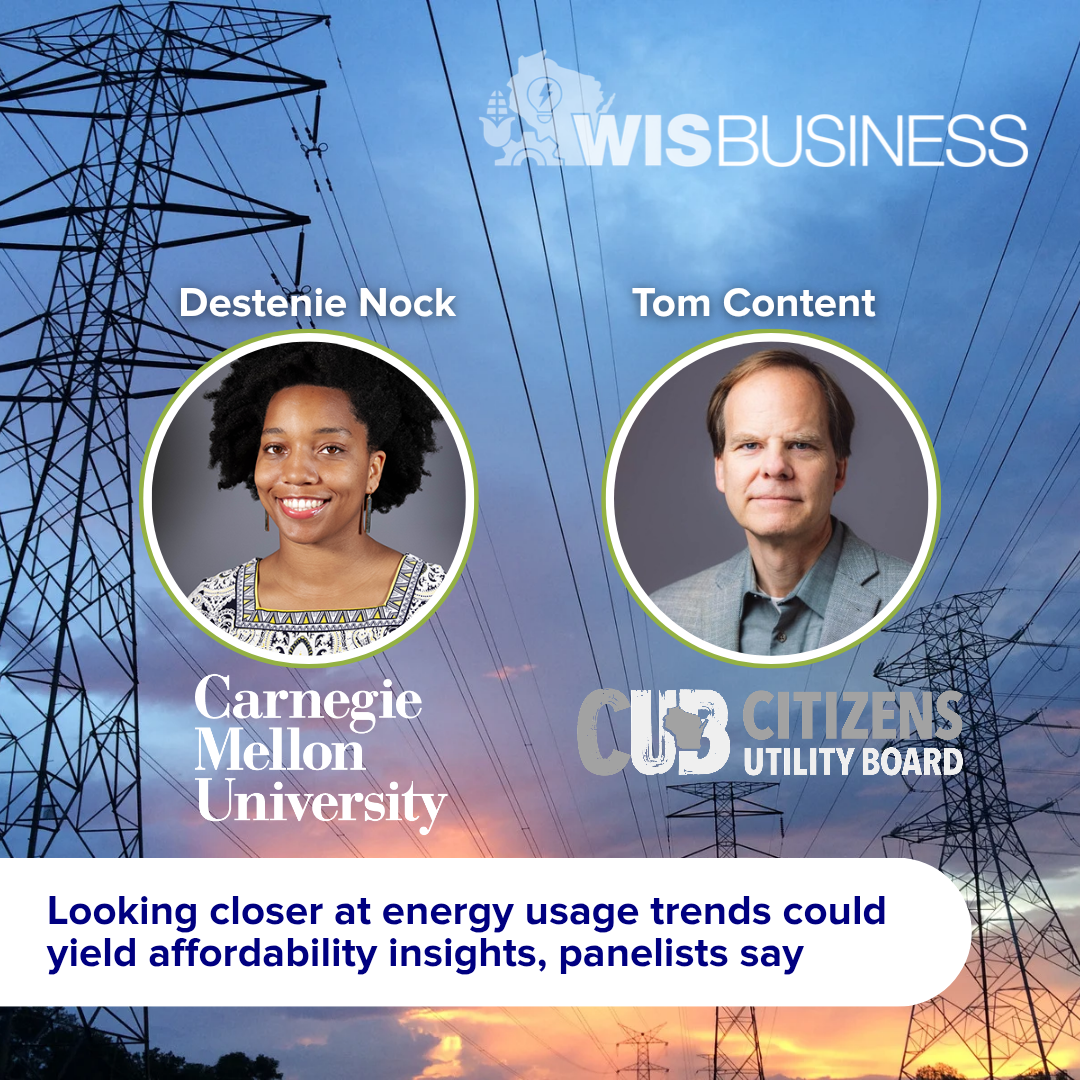
Looking closer at energy usage trends among utility customers could yield insights about affordability challenges in Wisconsin and elsewhere, panelists said at a recent Customers First Coalition event.
Destenie Nock, an associate professor of civil and environmental engineering at Carnegie Mellon University, said assessing typical energy usage trends among households in a given utility’s territory can provide a useful metric.
“If you know that, now you know who’s in energy deprivation and who is energy-efficient,” she said last week. “I think that that is so important for our field. It’s something that we’ve been working on and I think it allows us to have these really rich, proactive conversations about customers.”
Nock highlighted customers engaging in “energy-limiting behaviors” due to financial challenges, such as using less heat or air conditioning or other appliances. In some cases, people are taking “dangerous” approaches to heating their home like running an open oven or rerouting dryer vents back into the house, she said.
Citizens Utility Board Executive Director Tom Content said legislators and energy regulators like the state Public Service Commission “need to follow the data” when it comes to addressing affordability issues in Wisconsin.
He referenced a national consumer advocacy resolution from about four years ago calling for utilities to track disconnections, payment late fees, customers with medical payment arrangements, public assistance recipients, and numerous other factors indicating energy affordability.
“I think we’re going to need to add to that new metrics based on our talk today by Dr. Nock,” Content said. “We need to be able to track this energy-limiting behavior … The data’s out there to find out more about what’s really going on, so that’s another step forward we could take.”
Nock agreed “there’s so much data out there” to identify customers teetering on the brink before they enter a crisis, noting it’s much more difficult to help them after the fact.
“Because now you’ve got bad debt on the books, the family’s in crisis, they’re trying to run away from the utility, y’all are trying to chase after them and they just don’t want … their lights to get cut off, right, or their heating,” she said.
The state’s Wisconsin Home Energy Assistance Program or WHEAP helps eligible households cover the cost of heating and electricity, funded in part by the federally supported Low Income Home Energy Assistance Program.
Meanwhile, members of the public are growing more aware of energy affordability challenges as these issues have begun hitting the middle class in addition to low-income households, Content noted.
“We’re seeing it in terms of the data we’re tracking, not just the low-income, but the increase in moderate income households who are struggling to make ends meet who are ineligible for energy assistance programs but they’re working two jobs, and if they lose one of them they could fall into that,” he said. “That trend over time is going up.”