
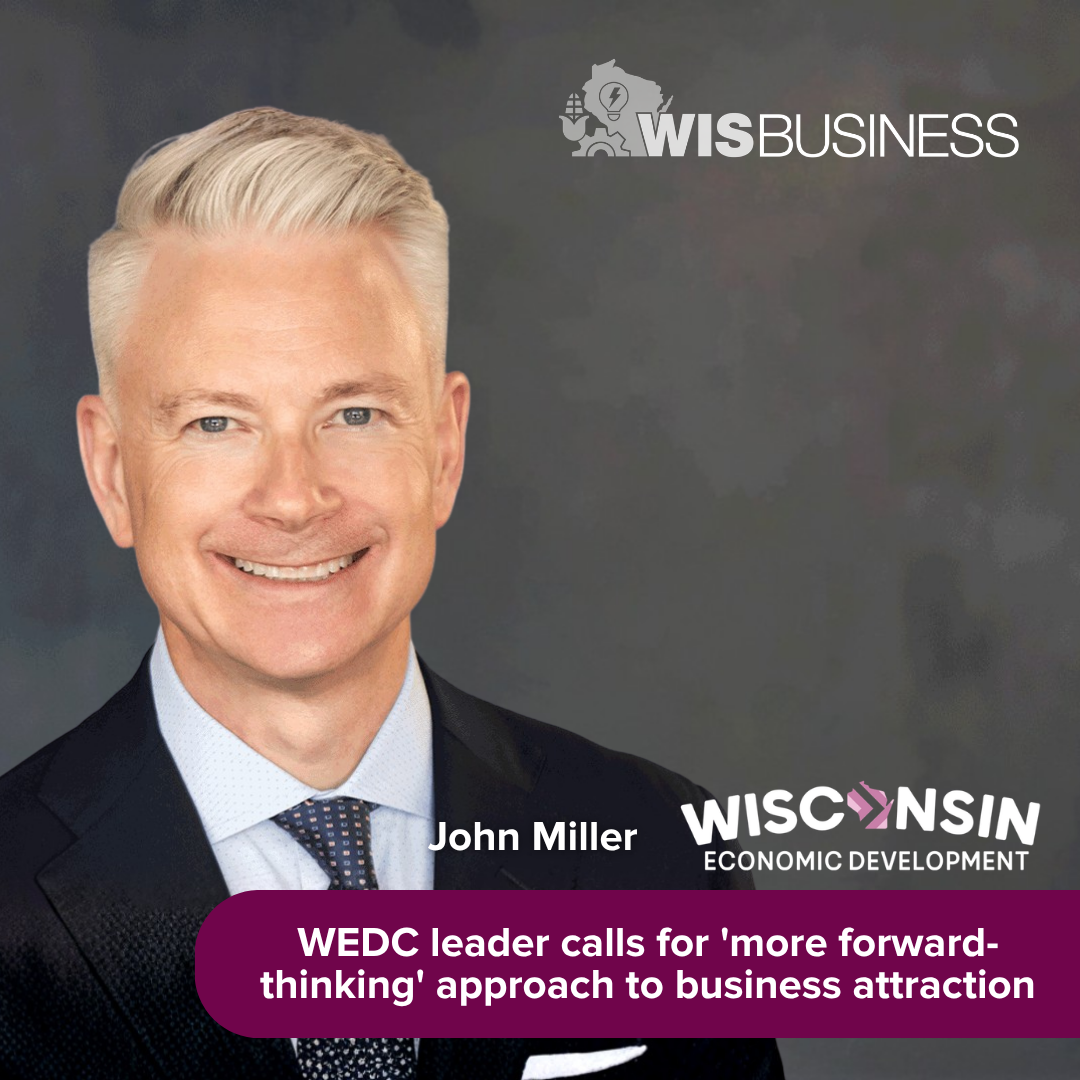
WEDC Secretary and CEO John Miller says Wisconsin needs to be “a little bit more forward-thinking” about landing capital investment by businesses before they’re entrenched elsewhere.
“It’s very hard to get, as we’ve seen, companies that are fully baked to move their headquarters,” Miller said yesterday during a luncheon hosted by WisPolitics-State Affairs and the Wisconsin Technology Council.
Full transplants of company headquarters do happen, Miller noted, pointing to the manufacturer Caterpillar leaving Illinois for Texas in recent years. And with the state’s lower office building occupancy rate in the post-pandemic era, “we should be in the play for some of those things,” he argued.
“But we also need to make sure that we start at a lower level to make sure that we’re capturing some of these opportunities when they’re in their growth stage,” Miller said. “It’s a little bit longer waiting period, but I think it’s a good way to start.”
He also addressed the state’s “brain drain” challenge, saying “there’s no doubt that we need to do a better job” of selling the benefits of staying in Wisconsin post-graduation.
Although the state routinely has more than 100,000 open job listings at any given time, its unemployment rate remains near-record lows, standing just above 3% at last count, he noted.
“So where’s the give? We need to have more people not only coming to Wisconsin to go to college and learn, but also staying here after,” he said, emphasizing the importance of developing more housing and childcare options to support the state’s workforce.
Meanwhile, Miller stressed the need for greater venture investment activity to support Wisconsin’s startup ecosystem. His own background includes founding the venture capital fund Arenberg Holdings LLC in Milwaukee in 2015, and serving on the UW Board of Regents.
“With regard to capital … we desperately need to have bigger and more,” he said, adding “we have a couple of great new Wisconsin-based venture funds that are raising money, and we also have some others that are raising at a different level, to engage in a higher level … but it is something that will never drop off, the need for Wisconsin to focus on.”
In response to an audience question about controversies surrounding the energy-intensive data center projects being developed in Wisconsin, Miller pointed to the “thousands and thousands” of jobs being created by these projects.
In addition to the construction work needed for the multi-billion dollar developments, he also touted the partnerships being created by tech companies, such as Microsoft’s work to establish Green Bay’s TitletownTech VC fund and the Microsoft AI Co-Innovation Lab at UW-Milwaukee.
“So there’s a lot of good being derived from this data center work,” he said.
Still, he acknowledged concerns being voiced about the projects, noting “stressful areas” for state residents such as their massive energy consumption and water usage.
But with more than 40 other U.S. states already building data centers, he argued: “Wisconsin can’t lose out on that type of innovation, otherwise we’re going to get left behind.”