

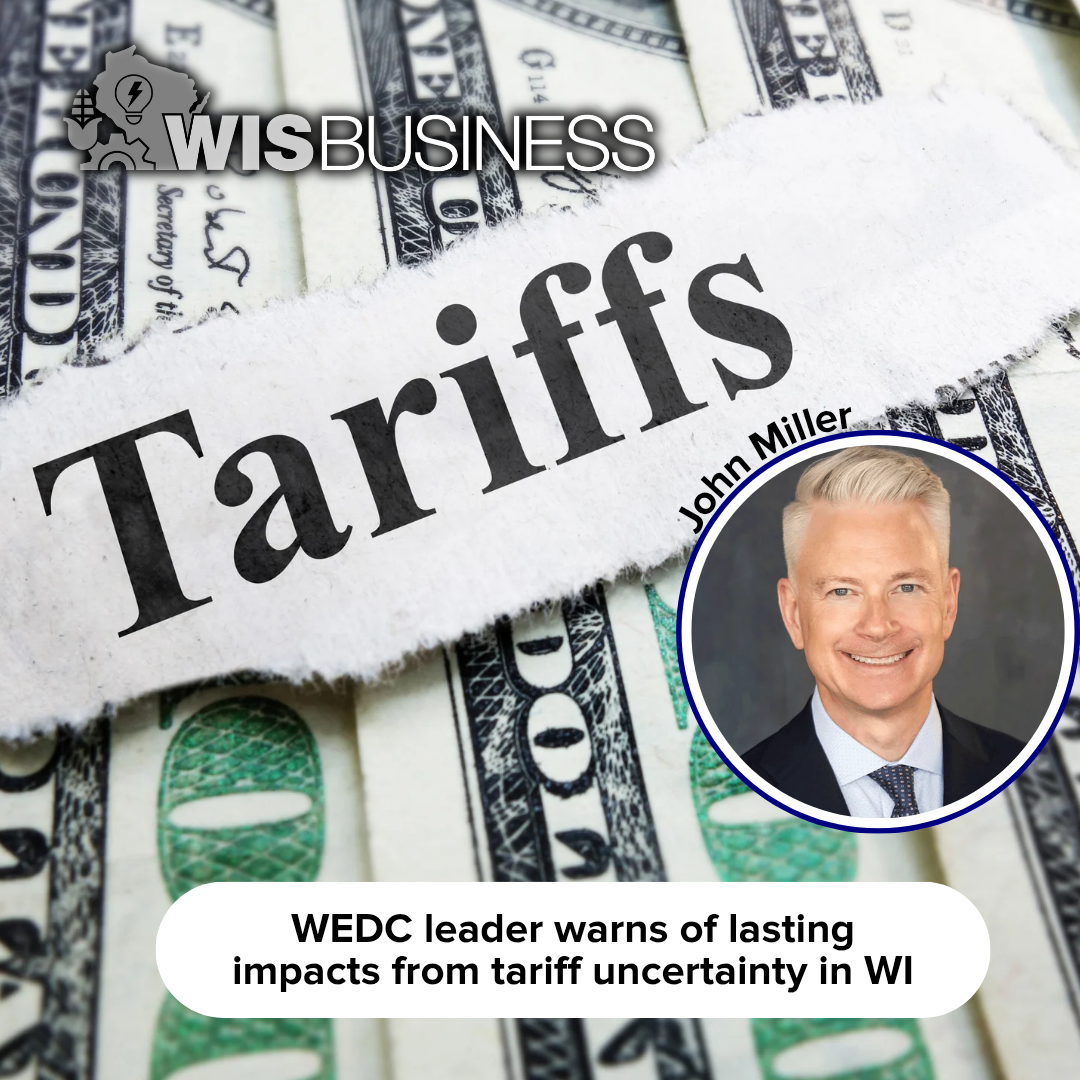
The head of WEDC warned tariff-related uncertainty will have “lasting and fairly negative” effects on the state economy, noting Wisconsin’s dependence on trade with Canada.
John Miller, secretary and CEO of the Wisconsin Economic Development Corp., yesterday addressed members of the state agency’s board of directors.
His comments followed President Donald Trump enacting new import restrictions on about $1 billion worth of Canadian goods, alleging discrimination against U.S. products by its northern neighbor. Canada earlier this month announced it would match U.S. Section 338 tariffs “dollar for dollar” on about $27.6 billion worth of goods.
Miller yesterday highlighted his recent remarks to the Great Lakes Economic Development Council in Milwaukee, focusing on the importance of economic relationships between Great Lakes states and Canadian provinces even amid federal trade clashes.
“It was the Canadians after the event that rushed up to me with their cards out wanting to continue conversations about how we can better collaborate at the state and provincial level, so that was really encouraging,” Miller said.
Still, he said he doesn’t want to downplay the significance of the tariffs enacted by the United States and Canada in the latest escalation in trade tensions, noting Canada remains Wisconsin’s top trading partner by far.
“The absence of any certainty in the tariff landscape is going to have lasting and fairly negative effects on many of our industries and also a lot of our consumers,” Miller said yesterday. “And not only the industries that produce in Wisconsin that ship abroad, but of course a lot of our companies in Wisconsin use Canadian suppliers.”
Meanwhile, agency staff are exploring the possibility of experimenting with “ratcheting up” part of WEDC’s investment portfolio to be more aggressive. That’s according to WEDC Vice President of Entrepreneurship and Innovation Shayna Hetzel, who yesterday said that could include taking “earlier, riskier bets” with the investments the agency makes.
“More to come over the next few months and year as we explore what’s next,” Hetzel said.
Yesterday’s board meeting included a look at the state’s Technology Development Loan program, which provides venture debt financing for qualifying early-stage startups.
Between fiscal years 2016 and 2022, the program put much of its support behind recipients in the state’s southern portion, with 64% of awards going to recipients in Dane County. Other counties in southeastern Wisconsin made up much of the award pool, including Milwaukee County with 15%, Waukesha County with 7% and Washington County with 2%.
Ed Roeger, senior director of strategic performance for WEDC, noted TDL program recipients “track closely” with the state’s venture capital ecosystem, leading to the concentration of recipients in these areas.
Similarly, recipients were also clustered in manufacturing, information technology and professional, scientific and technical services sectors, with a focus on healthcare and IT markets, according to Roeger’s presentation.
“That kind of checked in some ways for us that okay, the program does look like it is supporting the overall VC space out there, and looks pretty strong within that,” he said yesterday.
During the study period, the TDL program provided more grant support for businesses in the later stages of development, with more grants of around $300,000 going to companies that are commercializing and launching or growing and expanding.
By comparison, fewer grants of about $160,000 on average went to earlier-stage businesses in the product development stage.