
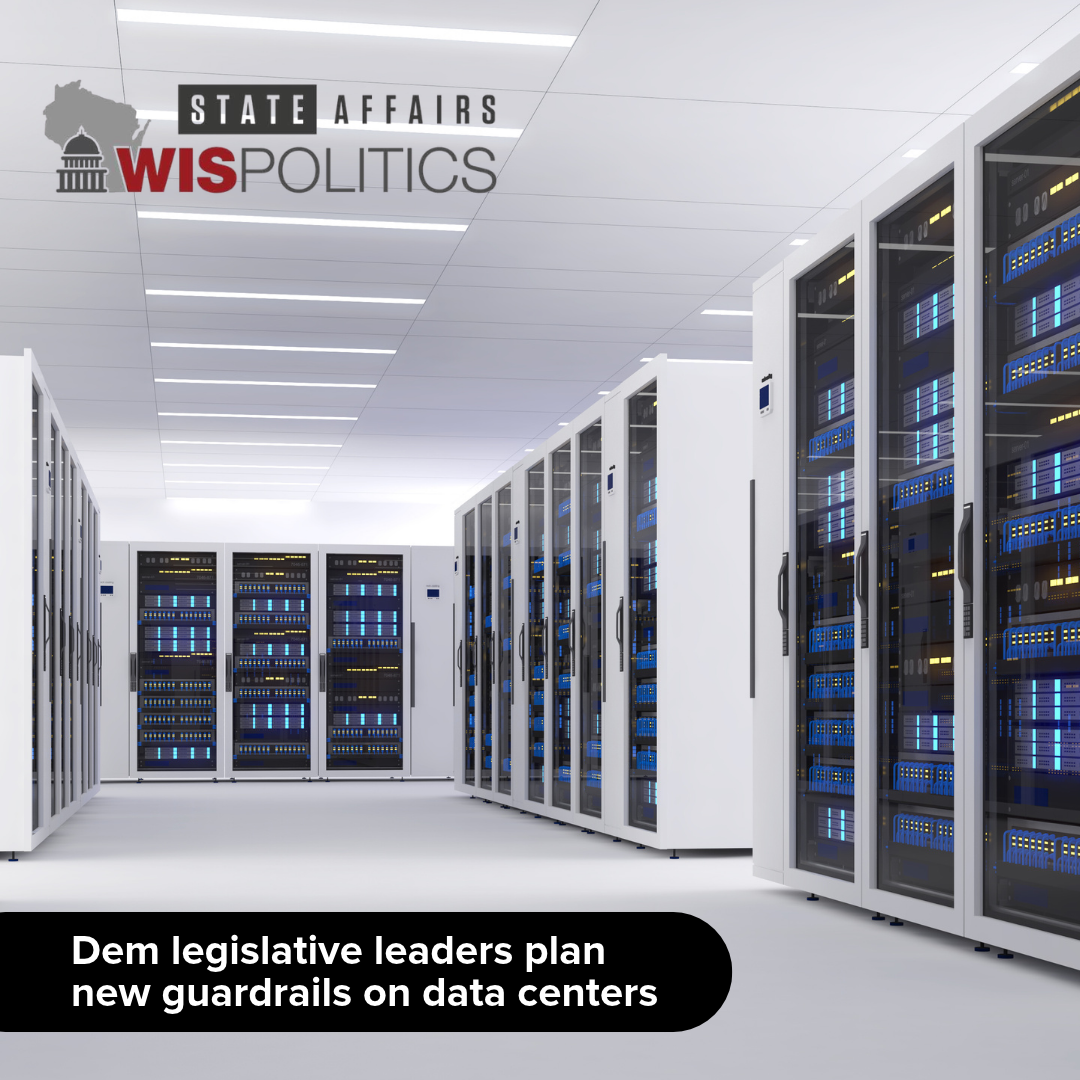
Incoming Dem legislative leaders Dianne Hesselbein and Greta Neubauer told WisPolitics their caucuses will look to place new guardrails on data centers after they take control in January and will start with bills their members have already authored.
Still, neither favors a moratorium on the projects, as some in their party have called for.
“That’s not the frame we’re in right now,” Neubauer, D-Racine, said in a phone interview. “We understand that the economy is changing here, and our goal is to make sure that the people of Wisconsin get the best deal possible.”
How the Dem majorities deal with data centers will be one of several key issues facing lawmakers as they convene next session amid the growing public backlash against the huge projects. That’s particularly true as Dems try to balance those concerns with labor supporting the projects, which have helped drive job growth in some areas of the state as well as nationally.
They’re also coming off a campaign cycle in which both sides used data centers to attack the other. GOP gubernatorial candidate Tom Tiffany, for example, sought to label Dem David Crowley as “data center David” after the Milwaukee County executive declined to embrace a moratorium on the projects. As the campaign wore on, Crowley expressed an openness to repealing a sales tax exemption for the projects that Republicans inserted in the 2023-25 budget that Dem Gov. Tony Evers signed.
Neubauer, whose Assembly district includes the Microsoft data center in Mt. Pleasant, said among other things, “we do need to look at that sales tax credit.”
Hesselbein said legislation placing new restrictions on data centers is a priority, though “It’s not going to be SB 1.” She said members heard concerns from voters on the doors about the projects, but she wanted to speak with her caucus before publicly commenting on a possible repeal of the sales tax exemption.
The exemption allows qualified developers to avoid paying the sales tax on most purchases supporting the construction and operation of a data center. The Legislative Fiscal Bureau estimated Wisconsin will lose out on $1.5 billion in revenue related to data center construction between 2024 and 2028. In addition, the state is expected to forgo $369 million annually in sales tax revenue related to their operations.
“It’s a lot of money, and it’s something that is a serious conversation that we have to have,” Hesselbein said.
In July, Crowley, during an interview with WisconsinEye and WisPolitics ahead of the Dem primary, said he would like to see the sales tax exemption repealed. In August, he suggested if data centers want any kind of tax break, they should have to earn it through relying solely on renewable energy with a guarantee that powering them wouldn’t increase consumer rates, among other things.
He’s also suggested there could be a pause on data center development until new guardrails are put in place, and during a gaggle with reporters on the UW-Madison campus two weeks ago, Crowley expressed an openness to signing a repeal of the sales tax exemption if lawmakers approved one.
“This is something that we’ve heard all across the entire state, and I think that when you look at the fact that these billionaires as well as Big Tech companies who are receiving tax breaks on the backs of hard-working Wisconsinites’ healthcare, we can’t continue to just give them a free ride, and I’ve been very clear on that,” Crowley said.
Data center ads played outsize role in election communications
Microsoft Corp. announced plans in spring 2024 to build a $3.3 billion data center in Racine County at a site that had been cleared for a planned Foxconn development that fell well short of initial expectations. Though originally hailed as a massive investment that would drive job growth, the public began to sour on the projects not long after.
The latest Marquette University Law School Poll found 76% of registered voters said data centers weren’t worth the cost, compared to 55% a year earlier.
At the same time, data centers ranked ninth when voters were asked to list their most important issue this fall. Forty-eight percent said the cost of living, while 4% answered data centers.
Still, they were one of the most prevalent topics in campaign ads during the general election, ranking fourth in terms of spending, according to a WisPolitics review of AdImpact data.
AdImpact tracked more than 80 different creatives that mentioned data centers and over $29.2 million spent.
Taxation was the most popular topic with $92 million spent across 179 creatives, according to AdImpact.
In second place was ads that mentioned healthcare, which topped $54 million in spending, across 155 creatives. Crime was the third most expensive topic at $31 million but only had 36 creatives.
The AdImpact tracked ads under multiple categories. For example, an ad mentioning tax breaks for data centers would be classified under both taxation and data centers.
Past bills give guide to future Dem efforts
Democrats this session introduced or signed onto multiple data center bills that didn’t become law, ranging from a proposal for a statewide data center moratorium to requiring data centers to use renewable energy in order to qualify for tax exemptions.
Hesselbein singled out a bill co-authored by Sen. Jodi Habush Sinykin, D-Whitefish Bay, and Rep. Angela Stroud, D-Ashland, as a starting point for discussions next session.
Introduced as AB 722 and SB 729, the wide-ranging package sought to require data centers in Wisconsin to get at least 70% of their power from renewable sources in order to be certified by WEDC for tax exemptions — a sticking point for Republicans.
They voiced concerns about the proposal in February during a hearing before the Senate Committee on Utilities, Technology and Tourism, after it was introduced late last year.
The legislation would also have required data centers to pay the prevailing wage rate during construction or refurbishment, or a union-negotiated wage, while codifying a new ratepayer class under the state Public Service Commission for these energy-hungry projects.
While the bill authors defended their proposal and called for working across the aisle to regulate data centers, they also told the committee they opposed separate Dem legislation that would have imposed a statewide data center moratorium.
That bill, introduced as AB 1099 and SB 1061, would have banned the operations of all data centers in Wisconsin until a laundry list of requirements were met, including that 100% of the energy for such projects come from newly built renewable sources and the elimination of all state and local subsidies for data centers.
The “Pause to Protect” bill was introduced by Sen. Chris Larson, D-Milwaukee, and Rep. Darrin Madison, D-Milwaukee, who said at the time it would establish “robust safeguards” for data centers in the state.
Meanwhile, another data center bill initially proposed by Republicans in February later got some Dem support as Beloit lawmakers Sen. Mark Spreitzer and Rep. Clinton Anderson signed on in March as co-sponsor and co-author, respectively.
The legislation — AB 1036 and SB 969 — aimed to ban nondisclosure agreements for data centers that hid development deals from the public, with exceptions for NDAs established solely to protect trade secrets.
None of these bills made it through the legislative process this session, but the imminent Dem control of state government following the midterm election this week will create an opportunity to revisit the question of how to regulate data centers in Wisconsin going forward.
When asked about the possibility of bringing back her data center proposal in the coming legislative session, Stroud said Republicans “have had every opportunity” to address data center regulation.
“They refused to hold a vote in the Senate. And the Assembly voted on a bill that even the PSC said was unworkable,” she said in an emailed statement, referring to a GOP-authored proposal to establish various requirements for data centers. “They failed to respond to what the public has been demanding. That ends now.”
She argued voters have given Democrats a mandate, and they will use it to pass strong data center regulation that puts the public first. The statement did not specifically address whether the proposal from this session would be revived.
Similarly, Habush Sinykin said she’s ready to work with legislative colleagues and Crowley to “hold big tech accountable” but didn’t say whether she’d reintroduce the same proposal from this session. Still, she expressed confidence the new legislative leadership will be able to advance legislation to protect ratepayers, the state’s natural resources and residents.
“Wisconsinites from across the political spectrum and state are demanding action from their state legislators to pass strong regulatory guardrails and protections against data centers,” she wrote in an email.
Meanwhile, Spreitzer says he continues to support banning data center nondisclosure agreements and plans to work with colleagues in the new majority to “pass comprehensive data center legislation, including an NDA ban, as well as regulations on AI itself.”
Public + utility response
Wisconsin residents have largely rejected hyperscale data centers as public attention has focused on factors such as their size, energy demand, effect on landscapes, water use and environmental harms from new natural gas-fired plants being built to serve them.
The Microsoft project in Racine County is the only hyperscale data center currently in operation. Two are under construction in Beaver Dam and Port Washington.
According to UW-Madison Extension, 26 of the state’s 72 counties have an active data center moratorium as of October, with more considering a ban or passing ordinances to regulate their presence. And municipalities across the state have passed their own moratoriums.
Plans for new hyperscale data centers have largely stalled out in 2026, with residents in communities from Caledonia to Menominee to Wisconsin Rapids working to scuttle developers’ proposals.
In Walworth and Kenosha counties, two proposed natural gas-fired plants expected to serve We Energies data center customers were met with considerable backlash from environmental groups and some locals.
The PSC approved both projects last month, though not before the regulatory agency’s chair expressed frustration about commissioners’ limited ability to consider the pollution created by the plants under state law.
Despite that backlash, Wisconsin utility executives have said they’re planning for further data center load growth or hinted at plans for more data center customers.
WEC Energy Group CEO Scott Lauber said on an earnings call last week that the company was planning for another 400 MW of load growth from a new customer.
He also said the company plans to invest $47.5 billion on capital projects between 2027 and 2031, up $10 billion from its previous 5-year plan, with the majority of that increase driven by very large customers.
Alliant Energy a day later increased its four-year capital spending forecast by 19% to $15.9 billion, driven in large part by data center spending.
The Madison-based utility told investors to expect new data center projects in Wisconsin. The utility is in “advanced discussions” to add another 2-4 GW of large-load growth in Wisconsin and Iowa, on top of the 3.4 GW it’s adding for four data center projects, including Meta’s Beaver Dam campus.
Asked about Crowley’s comments on pausing data center development, Alliant CEO Lisa Barton said the cost savings customers would see from data centers paying for new infrastructure would speak for itself.
“We’ve always had practical and pragmatic leadership at the state level, while we continue to feel that when we show everyone the facts behind the numbers that the support for data centers will be there,” Barton said.
Utility executives have argued the facilities will save ratepayers money by absorbing the costs of new power infrastructure that would have been necessary anyways.
Madison Gas & Electric, Xcel Energy and Alliant have all submitted applications to create a new rate class to bill data center customers; the PSC approved We Energies’ large-load tariff in April, while Alliant is serving its sole Wisconsin hyperscale data center in Beaver Dam through an individual contract approved by regulators in May.
Editor’s note: For the rest of this year, WisPolitics and the State Affairs network are covering how election outcomes will shape the 2027-28 legislative session in Wisconsin.
The coverage includes deep dives into the issues and the people who will shape the upcoming session.
The effort is called the “SA 6” — a half-dozen people or issues that State Affairs will follow throughout the fall. See more.