
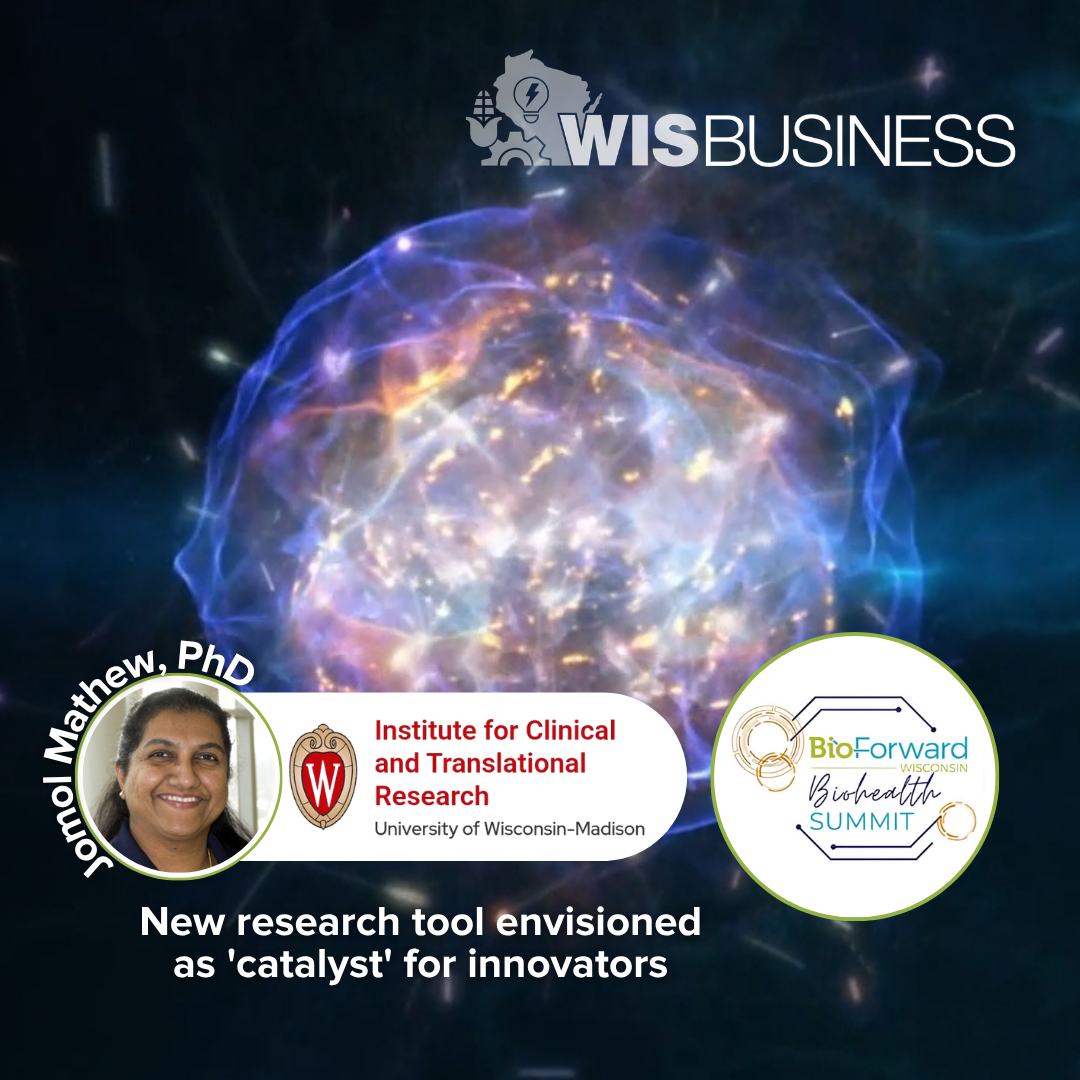
A new research tool being developed through the Wisconsin Biohealth Tech Hub is expected to go live by next summer, offering a “catalyst for all the innovators” by unifying fragmented health data.
That’s according to Jomol Mathew, associate dean for informatics with the UW-Madison School of Medicine and Public Health. Speaking last week during BioForward Wisconsin’s Biohealth Summit in Milwaukee, she provided an update on one of five projects being funded through the state’s tech hub effort.
Mathew noted healthcare data is split across various hospital systems in Wisconsin, each of which has only an incomplete view of the state’s entire patient population. This poses a challenge for research projects — one that the Wisconsin Health Data Hub is seeking to address.
“So for example if you’re studying sickle cell anemia, we may not have an adequate number of patients in any of our single sites,” she said. “It would be great if we can put it together, so that’s the whole purpose of this.”
By combining data from participating health systems, the project aims to create a more complete picture of the state’s patient landscape while respecting data privacy and enabling better analysis. Partners in the effort aim to create a “federated query” that scientists and others can use to answer complex questions.
“So if you’re an innovator and you want to see, where are the patients with this particular condition, you’ll be able to run a query and see that the patients are either in the northern parts of Wisconsin or southern parts of Wisconsin,” she said, noting this will guide partnerships with specific health systems.
The tool could also provide greater insights about trends in disease over time, as well as contributing factors. Mathew said this could inform policymaking efforts in addition to research, pointing to lead poisoning as one example.
“So if you see a lot of lead toxicity in a particular area, you may be able to then develop a policy or come up with a program to address it,” she said.
Following initial data standardization and work to develop a connected network, partners are developing an “extensive” governance framework given the sensitivity of the information being used. Users will be able to request detailed datasets from participants, to build a registry for specific diseases or other applications.
“If you’re a pharma company and you’re thinking about site identification, this may be a great resource … similarly, if you are a small company trying to develop an AI model, you’ll be able to come and securely develop that model in our our enclave with the right set of data,” she said.
Hear more about the tech hub projects in an earlier podcast.