
— By Brian E. Clark
For WisBusiness.com
If not for the running craze of the 1970s, Wisconsin’s Trek Bicycle Corp. might never have come to exist.
Some five decades ago, Trek co-founder and serial entrepreneur Dick Burke became a running enthusiast, eventually competing in Boston Marathons and numerous other races.
And that led him, in a roundabout way, to connect with Madison bike store owner Bevil Hogg. The native of South Africa teamed with Burke to start what has become one of the globe’s largest bicycle makers.
The privately held company — which is celebrating its 50th anniversary this year — has had its trials. But it thrived and now has annual sales Forbes Magazine has pegged at nearly $2 billion.
And each year, Trek sells around 1.5 million bicycles, estimated John Burke, who heads the company his father co-founded. Globally, 143 million bikes — worth $60 billion — are sold each year, most of them in China.
Headquartered in a sleek, stylish building in Waterloo, not far from the rustic, 7,000-square-foot red barn where Trek was launched with a handful of employees, it now has around 800 workers in Wisconsin and 5,000 worldwide.
And those workers enjoy being there, ranking No. 42 in the Fortune list of the “100 Best Companies to Work For.” That’s up from 94 in 2023. Even better, Trek came in at No. 6 on the top places to work in retail.
Burke said his father was out of shape before he got into running.
“He got into fitness in a big way and cycling was part of that,” said the lanky, 64-year-old Burke, who became president of Trek in 1997. His father — who stood 5’8″ and was affectionately known as the “Big Guy” — died in 2008 at age 73.
John followed in his father’s athletic footsteps and ran three Boston Marathons with his dad. Furthermore, he logs more than 3,500 miles a year on his bikes, often riding with his wife Tania, who heads Trek Travel, a cycling and active vacation company based in Madison that will turn 25 next year.
Frequent Saturday outings for the pair feature 120-mile spins from Madison to Mazomanie to Spring Green to Sauk City and then home. And this month, they’re cycling in the Alps over grueling mountain passes featured in the Tour de France.
“We love climbing,” he said.
Father and son, John recalled, went on their initial overnight bike trip in 1974 when he was only 12 years old.
“It was just as dad was getting into the bike thing with Bevil,” he mused. “We pedaled from Hartland up to Fond du Lac and then came back the next day on some Fuji bikes he’d bought in Milwaukee. That was our first big cycling adventure, and we rode about 60 miles each way.
“But truth be told, we didn’t have a clue about what we were doing,” he added with a chuckle.
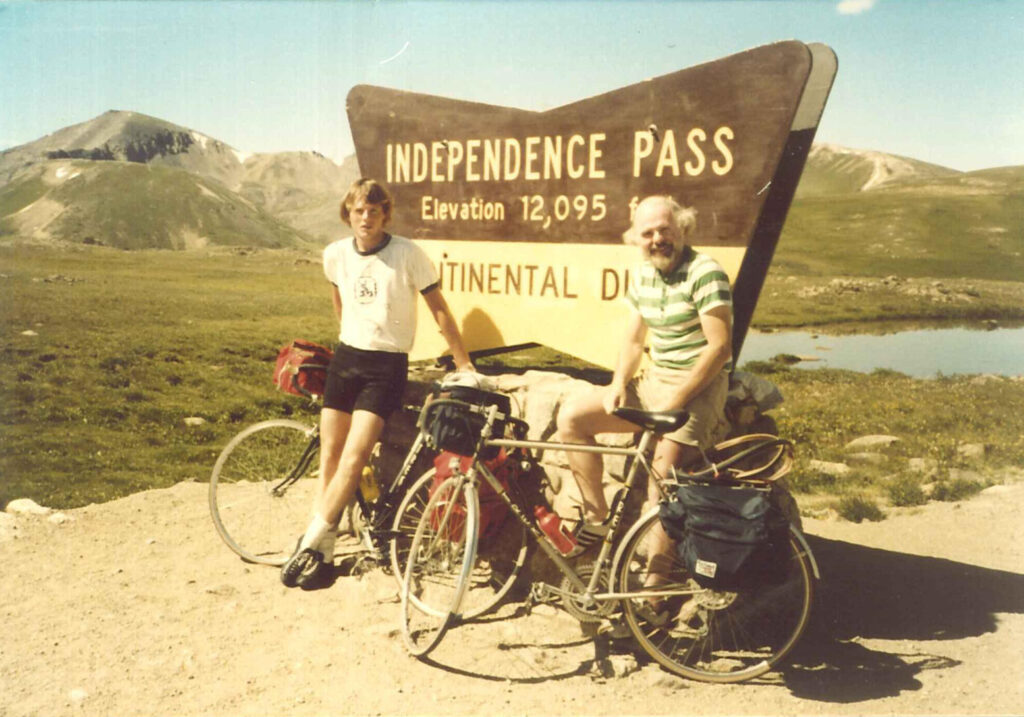
There were more trips, said Burke, who began working at Trek as a high school freshman, loading boxes and taking inventory. A much-prized photograph shows father and son at the 12,095-foot summit of Colorado’s Independence Pass during a 1982 bike trip.
Burke said the company took off in the years after its launch in 1976, when it manufactured around 900 touring bikes and sold its first model to a shop in Minnesota.
“Sales went up, up and up some more into the early 1980s,” said John. “Then it kind of hit a speed bump in 1985, and we began paying the price for some mistakes we’d made.”
The following year, Hogg departed following management disagreements with Dick Burke.
Their relationship has been described by Hogg as “oil and water,” with Hogg the artist and Burke the businessman. But John said there was no lingering bitterness.
And for the 50th anniversary, Hogg, who now lives in California, was invited back and featured in the two-day celebration, as well as in a coffee table book about Trek. The event was held in Madison’s Orpheum Theater on June 18 followed by a gathering in Waterloo on June 19 and the Trek 100 charity cycling event on June 20th.
“I never heard my dad say a bad word about Bevil, who he always held in high regard. But I know the split must have been hard,” Burke said.
Burke said he hadn’t spoken to Hogg in more than 40 years. Having him return to Wisconsin to reconnect for the anniversary and be part of a film about the company was poignant, as well as a delight, Burke said. They spoke for more than two-and-one-half hours for the movie, though only 20 minutes was ultimately used.
Hogg, in an email, said the “oil and water collaboration between a finance guy and a European would-be entrepreneur (myself) that actually worked out very well and laid the foundation for subsequent success.
“I had come up with the idea of the company, and did a lot of the early work in getting it started while Dick courageously provided the funding as well as financial oversight.
“Dick and I parted ways after about 10 years at a time when the company was losing money — I was pushing for more technology and new materials (like aluminum and carbon fiber) while Dick wanted to scale the company and turn a profit.”
Hogg left and founded the Kestrel Bike Co., which he said developed the first molded one piece carbon fiber bicycle frame.
Hogg lauded John Burke for making the company what it is today.
“Dick Burke with the help of John Burke succeeded in turning the company around and making it profitable,” he said.
“But, in my opinion, it was really John Burke who brought Dick’s and my divergent visions back together again and unifying them. I’m rightly considered one of the founders of Trek but, ultimately, the leader who brought everything together and made it happen was John.”
In 1984, just before the wheels started to come off, the younger Burke was working as a Trek sales representative in Colorado, covering 12 states in a little red Chevrolet Cavalier station wagon.
“I drove all around and ended up being really good at selling stuff,” he said modestly. “Trek was kind of hitting a peak and then it plateaued.
“I was out there watching this train wreck happen due to things like bad inventory, bad customer service and other problems,” recalled Burke.
“There is no greater education than being in the field and seeing your family business stumble. I take everything personally and this was really bad. A Greek philosopher once said to learn you must suffer. So I suffered and the company suffered, but we learned a lot.”
ThoughTrek didn’t go under, Burke said there were shareholders who wanted to shut the company down.
“Trek was not a financial success then,” Burke said. “But to my father’s credit, he said ‘We’re going to fix this place.’ And fortunately, he owned a bunch of other businesses that were doing really well.”
From his experience out West, Burke said he had plenty of ideas about what customers wanted.
“I knew all the problems and I knew how to sell,” he said.
So his father brought him home and put him in charge of customer service.
“I was able to get most of the things I wanted done,” he said. “And it sure didn’t hurt that I was the boss’s son. I wasn’t embarrassed by that position at all, like it might have bothered other people.
“I said, ‘Screw that,’ because I was laser-focused on taking better care of the customer than anybody ever could.”
Burke said that’s reflected in “Net Promoter Scores” of 96 (out of 100) from customers when asked if they would recommend Trek to a family member or friend.
And he touted the front page of every bike owner’s manual that says:
“Welcome to the Trek family. If you ever have a problem with your Trek, contact your retailer and they’ll take care of you. If they don’t, call Trek and Trek will take care of you. And if Trek doesn’t take care of you, here’s my email address. And I will.”
“Then I signed my name,” Burke said.
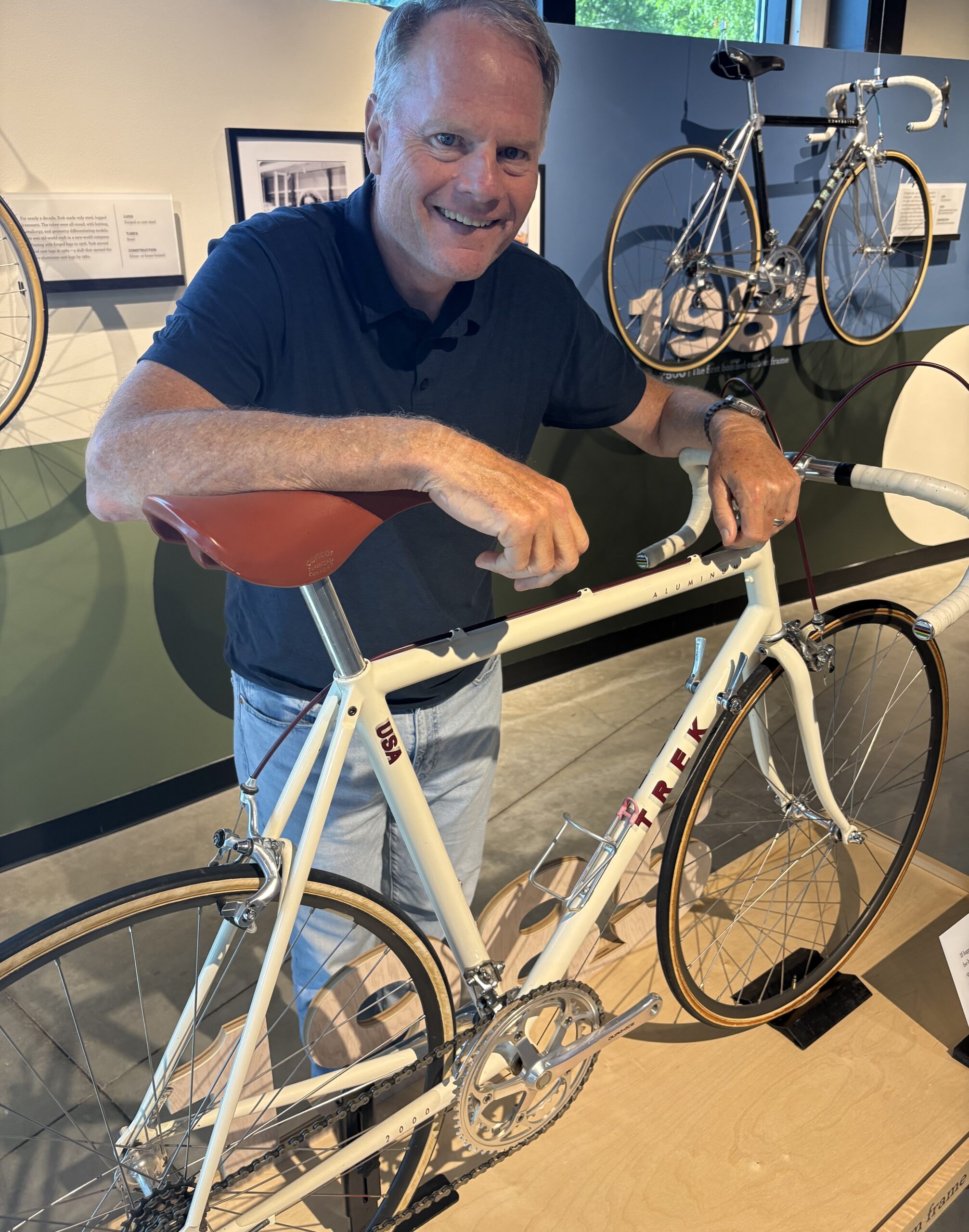
In the years since the company was launched, Trek bikes have evolved from steel to aluminum to carbon fiber. And from touring bikes to road (racing) bikes to mountain bikes and then a surge in e-bikes, which are now around 40% of the company’s sales.
“To survive and do well in this industry over 50 years, you have to be open to change,” he said. “We’ve been able to adapt to the market, whether it’s technologies, materials, or uses.”
In addition to traditional bicycles, Burke said Trek sells pedal-assist e-bikes, which top out at 28 miles per hour on flat ground, when the motor cuts off. Other models peak at a lesser speed of 20 mph, similar to what a serious cyclist can ride.
But he said he is worried about the e-bikes that kids and others are buying that can go more than 40 miles per hour without any pedaling.
A recent report from UW-Madison linked the rapid surge of e-bikes to a subsequent jump in accidents.
And a study commissioned by the Greater Madison Metropolitan Planning Organization found that e-bike and e-scooter crashes are consistently underreported because the state’s standardized accident reporting forms don’t differentiate between traditional bikes and electric devices.
Madison trauma centers, including UW Health and St. Mary’s Hospital logged a large spike in emergency room visits related to e-bike crashes. Powered scooter incidents have also increased dramatically, the report said.
Additionally, UW Health noted a concerning trend: children and teens, specifically boys under 16, account for a large portion of injuries, often because they are riding without proper helmets or using gear not rated for e-bike speeds.
“People consider them to be bikes, but they’re not,” Burke said emphatically. “They are motorcycles.”
He’s also bothered by the lack of regulations for what he considers these dangerous e-bikes.
“I’ve always said that good government matters. This problem has existed for several years now, but the vast majority of communities haven’t addressed it.
“Is it really that hard?” he asked. “I don’t think it is.”
Burke said his company benefited when famed pro cyclist Lance Armstrong — who was sponsored by Trek — was winning multiple Tour de France races and other competitions from the mid-1990s to 2004.
And he was saddened when Armstrong was stripped of his titles for doping.
“Trek got a huge boost, and so did every other bike company when Lance was on top,” Burke said. “When that sea rose, all the boats went up with it, including the Trek boat, for sure.”
Armstrong’s photographs are no longer on the walls at Trek.
“There was an emotional downside (to his fall) in that something you believed in wasn’t all it was cracked up to be,” he said.
“But a lot of people took up cycling because of Lance and I don’t think they regret that because in the end, riding bikes is a good thing for everyone’s physical and mental health.”
Another bump in the road for Trek occurred In 2014, when Burke’s sister Mary — a former state commerce secretary — was Democrats’ candidate for governor. Trek was harshly criticized by then GOP Gov. Scott Walker for outsourcing much of its manufacturing to China and paying low wages.
Before Mary decided to run, however, Walker’s administration had held up Trek as a Wisconsin success story.
Burke acknowledged that only 10% of Trek’s bikes are made domestically, but he noted that 50% of the company’s sales come from outside the United States. And one of its larger factories is not in China, but Hartmannsdorf, about 40 miles north of Dresden, Germany.
Walker also denounced Burke’s sibling, a former Trek executive, for not paying state corporate income taxes. That led to criticism of Walker from the conservative editorial page of the Wall Street Journal.
Like many other businesses in Wisconsin, Trek shareholders pay taxes on the company’s profits as individuals rather than through corporate taxes, John Burke noted at the time.
And following the COVID-19 pandemic, Trek was stuck with too much inventory, which slowed the business. Currently, Burke said tariffs are making life difficult for the company, forcing it to raise prices by 10% recently.
Difficulties aside, Burke said his father always believed that with its success, Trek had a responsibility to give back to the greater community.
“I’ve been lucky enough in my time here to see Trek make some incredible contributions to the world,” he said.
The Trek Foundation focuses on land preservation, trail development and youth cycling. Similarly, the Burke Foundation promotes urban education, human services and youth leadership development throughout southeast Wisconsin.
Major initiatives include the Trek 100 charity ride for childhood cancer, which has raised more than $16 million. The charities also support food drives, women’s cycling — including a female professional team — college scholarships, Milwaukee Youth Arts Center and the Urban Ecology Center.
“Interestingly, the Milwaukee Journal Sentinel honored my dad as philanthropist of the year in 2018, a decade after he died,” Burke said.
Kirsten Finn, Wisconsin Bike Fed’s executive director, praised Trek for not only making high-quality bikes, but also for its good works.
“Trek has always been about more than building and selling bicycles,” she said.
“The company is also deeply committed to making sure people have safe and beautiful places to ride them. In Wisconsin, Trek partners with the Wisconsin Bike Fed on statewide legislative initiatives and bike infrastructure projects to make our state an even better place to ride a bike.
“And, through their partnerships with national nonprofit organizations like the National Interscholastic Cycling Association (NICA) – which has gotten tens of thousands of kids on mountain bikes – and People For Bikes, Trek shapes bicycle-friendly legislation and supports inclusive programs for riders of all ages and abilities.”
She also lauded what she calls Trek’s “unparalleled” hospitality.
“That’s evident in the epic cycling events they produce,” she said. “Trek hosts the NICA championships, the annual CX Cup, and the Wisconsin Off-Road Cycling Series.
“As a founding sponsor of the Bike Fed’s ‘Ride Across Wisconsin,’ Trek set the bar high for customer service, great rest stops and incredible experiences on two wheels.
“These hallmarks are most clearly demonstrated at the world-class Trek 100, where the Bike Fed was honored to be included as a benefitting charity for the first time this year, and was on full display for the events surrounding the Company’s 50th Anniversary.”
Burke said he has no plans to slow down.
“I plan to keep on pushing what is our really simple mission statement,” he said.
“And that is to make awesome products our customers love, provide incredible hospitality and change the world by getting more people on bikes.”
But Burke said transition is something the Trek board discusses on an annual basis.
“One of my challenges is to make sure that Trek stands the test of time,” he said.
“I’m really proud that there’s an incredible group of people here who do an amazing job. I’d like to think Trek will be here 50 years from now.”
Clark is a Madison-based writer and photographer who also contributes to the LA Times and Chicago Tribune.