

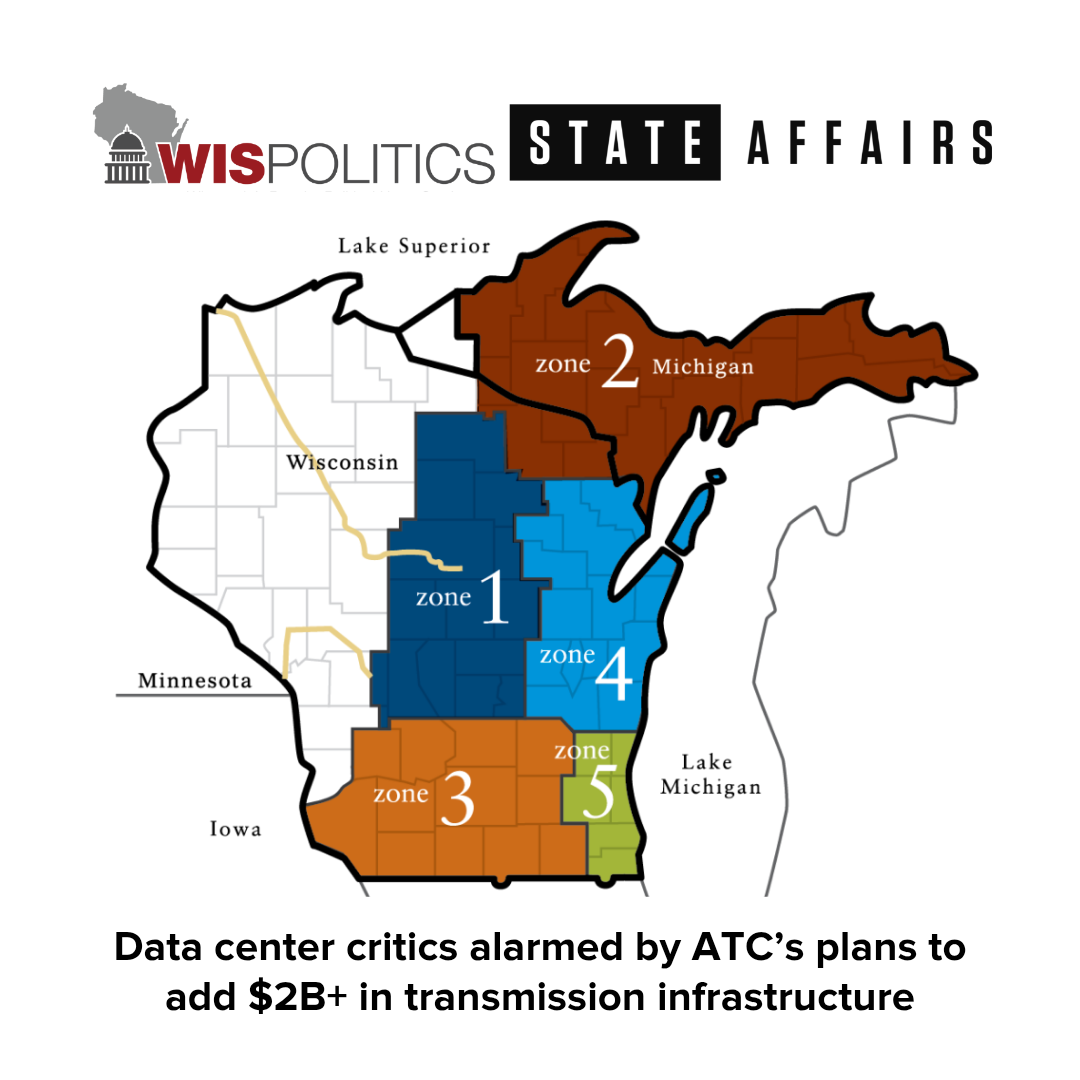
The utility that builds many of Wisconsin’s power lines wants to add more than $2 billion in new transmission infrastructure to serve Wisconsin’s data centers, alarming data center critics.
American Transmission Company LLC has requested or received approval from the Public Service Commission to build between $2.63 billion and $2.98 billion in new transmission lines and substations.
That includes two pending projects before the PSC that would serve Microsoft and Vantage’s data centers in southeastern Wisconsin. Also included in that total are three already-approved projects serving Microsoft’s Mount Pleasant campus and Meta’s Beaver Dam data center set to cost at least $1.18 billion.
Intervenors in two tariff cases before the PSC have raised concern about who will pay for that new transmission infrastructure, pointing out that ATC’s typical cost-sharing structure would require other ratepayers to cover the cost of much of the initial construction of these facilities.
“The tariff has to be passed under a no-harm standard, and our view is saddling customers with transmission costs does harm them,” said Tom Content, executive director of the Citizens Utility Board.
We Energies, which will power the Microsoft and Vantage facilities, says its data center customers will pay $564 million over the next two years to fully cover their related transmission costs. But the utility has offered limited detail; Microsoft and Vantage have also declined to offer additional comment.
“What our customers should know is that all parties agree that customer rates will not be impacted by data centers,” Brendan Conway, director of media relations for We Energies and WPS parent WEC Energy Group, wrote in a Thursday email. “That is the commitment the data centers have made.”
Both We Energies and Alliant, which serves the Beaver Dam data center, maintain that other ratepayers will not be impacted by the addition of new data centers.
In August and September of last year, ATC submitted applications to the PSC for two new transmission projects. One of those proposals, which would install between 90 and 102 miles of new extra-high voltage cable in and around Ozaukee County, is set to cost between $1.36 billion and $1.64 billion alone.
The transmission utility already had three other transmission projects pending before state regulators from the prior year;: these were approved between May and November of 2025.
Between all five projects, ATC is planning to install hundreds of miles of high-voltage transmission and build up to nine new substations across 11 counties.
All five of the applications cite the need for new transmission capacity to serve what ATC called in its application for one Racine County project the “unprecedented” load additions created by new hyperscale data centers.
All but one project cite several load interconnection requests submitted by We Energies to ATC.
The other $191 million project, in Dodge County, is located in Alliant’s service area and will serve the Beaver Dam data center.
ATC did say that one $423 million project located principally in Waukesha County would have been necessary anyway for reliability and system planning purposes, and was “not tied solely to any specific load.”
ATC wrote in a statement that it is “obligated to serve all requests received from power generators and local distribution companies (LDCs).
“Above all, we focus on keeping the grid safe, affordable and dependable for everyone in meeting this obligation,” read the statement.
The multi-billion dollar price tag on this new infrastructure has alarmed advocates like CUB and Wisconsin Industrial Energy Group, both of which have intervened in a pair of concurrent PSC rate cases that will decide how We Energies and Alliant will bill their new, energy-guzzling clients for power.
We Energies and Alliant have repeatedly said in those tariff cases that their other customers will not pay for new costs associated with data center development.
CUB Executive Director Tom Content notes, though, that neither the utilities nor state regulators reviewing the proposed contracts with data centers control how transmission costs are billed.
That’s decided by a federal cost-sharing formula, which distributes that cost across several Wisconsin utilities and their customers, including service areas that aren’t hosting data centers.
One $57 million project will have its costs shared among the Midcontinent Independent System Operator’s Midwest customer base, as will $40 million of another project.
“That’s more than $2 billion in costs that aren’t being directly assigned to the data centers and in fact are being assigned to utilities that don’t even have customers that are data centers at this time,” Content said.
Alliant wrote in a Friday statement that cost-sharing “supports system reliability while spreading costs fairly” and can lower costs for customers.
ATC is already billing utilities for the three under-construction transmission projects under an accounting practice called “construction work in progress.”
This poses its own problems: the federal cost-sharing formula that governs ATC dictates that transmission costs cannot be passed on to a customer that isn’t drawing power from the grid.
And at the moment, no data center is.
Meta’s Beaver Dam data center will come online sometime in 2027.
Vantage’s Port Washington facility is set to be operational in late 2027 at the earliest. Microsoft’s first data center is expected to become fully operational later this year, but its Mount Pleasant campus will remain under construction until 2028.
Until then, barring some change to federal rules, We Energies and Alliant’s other ratepayers will pay the cost of new transmission. A January analysis by PSC staff estimates that by 2028, We Energies customers will have paid between $112 million and $117 million more for transmission infrastructure than the data centers that infrastructure is built to serve.
And that assumes the data centers come online on time: Content says litigation over We Energies’ or Alliant’s proposed service contracts could further push those dates back.
Alliant said Friday its customers are not currently paying additional transmission costs due to a “built-in lag” between those costs being incurred and appearing in customers’ rates; We Energies said “non-data center transmission infrastructure” would be incorporated into customers’ bills as part of the rate process.
Alliant and We Energies point out in their filings that these same federal cost-sharing rules will allow them to bill data centers at a rate sufficient to recover the transmission infrastructure costs.
Alliant says it will recover those costs from its data center within 10 years, and that even if the Beaver Dam data center shuts down after five years, it would still recoup the infrastructure costs from a termination charge included in its proposed contract.
Consumer advocates, though, question what happens if the data centers fail to meet their forecasted demand capacity – particularly in the We Energies case, since its data center customers will principally benefit from the vast majority of the new transmission capacity.
In the We Energies case, PSC staff project it will take around 10 years for We Energies’ data center customers to pay back the cost of the transmission upgrades if those data centers operate at 100% of their projected demand.
If they only meet 75% of that demand, it will take 21 years; if the data centers only hit 50% of forecasted demand, it will take 45 years.
PSC staff also note there’s a scenario where infrastructure costs aren’t fully recouped if data centers terminate their contracts early.
CUB has proposed that data center customers should be required to pay directly for the new transmission infrastructure, but PSC staff say that’s not allowed under the federal cost recovery formula.
As a compromise measure, staff have suggested what’s called a “minimum billing demand charge,” which would require data centers to pay the cost of their full forecasted load regardless of whether the facility ever actually needs that much power.
Content called the proposal an “elegant solution.”
But We Energies, in its reply briefs, has argued the minimum billing demand charge departs from the federal cost-sharing formula and the PSC’s practices and “is not founded in fact or precedent.”
The utility has offered its own solution in a separate case filed with the PSC that will decide how much it can charge customers over the next two years.
In testimony included in that case, We Energies has proposed entering into an agreement with ATC where, once transmission lines go into service, We Energies will be billed the difference between data centers’ forecasted power demand and how much they actually draw.
We Energies would then bill its data center customers those additional costs. Per another filing, the data centers will pay a combined $195 million in 2027 and $369 million in 2028 – for a total of $564 million.
We Energies says that this will keep its customers as well as customers of other Wisconsin utilities from being saddled with the electric cost.
Instead of the PSC, the utilities would seek approval to change federal cost-sharing rules from the “Federal Electric Regulatory Commission” – presumably a typographical error meant to reference the Federal Energy Regulatory Commission.
ATC told WisPolitics it would be making a filing with FERC later this spring.
We Energies has declined to provide further information on the proposal to WisPolitics.
Content said CUB was still reviewing We Energies proposal, but noted that the utility had not made its proposal until after the deadline to submit information to commissioners on the data center contract case, which will be decided in April.
“The fix that they’re talking about is not something the commission can act on this month,” he said.
In an April 8 letter to the PSC, We Energies asked for regulators to approve its proposed transmission charge for data centers, without the minimum billing demand charge, since its working on addressing the issue with ATC and FERC.
Content says that would delay regulation on the issue until next year, after the second PSC case is decided and the ruling goes into effect.
“It’s almost asking for no protections for customers between now and January 1, in effect,” he said. “There’d be no resolution on this issue until the rate case is decided.”