
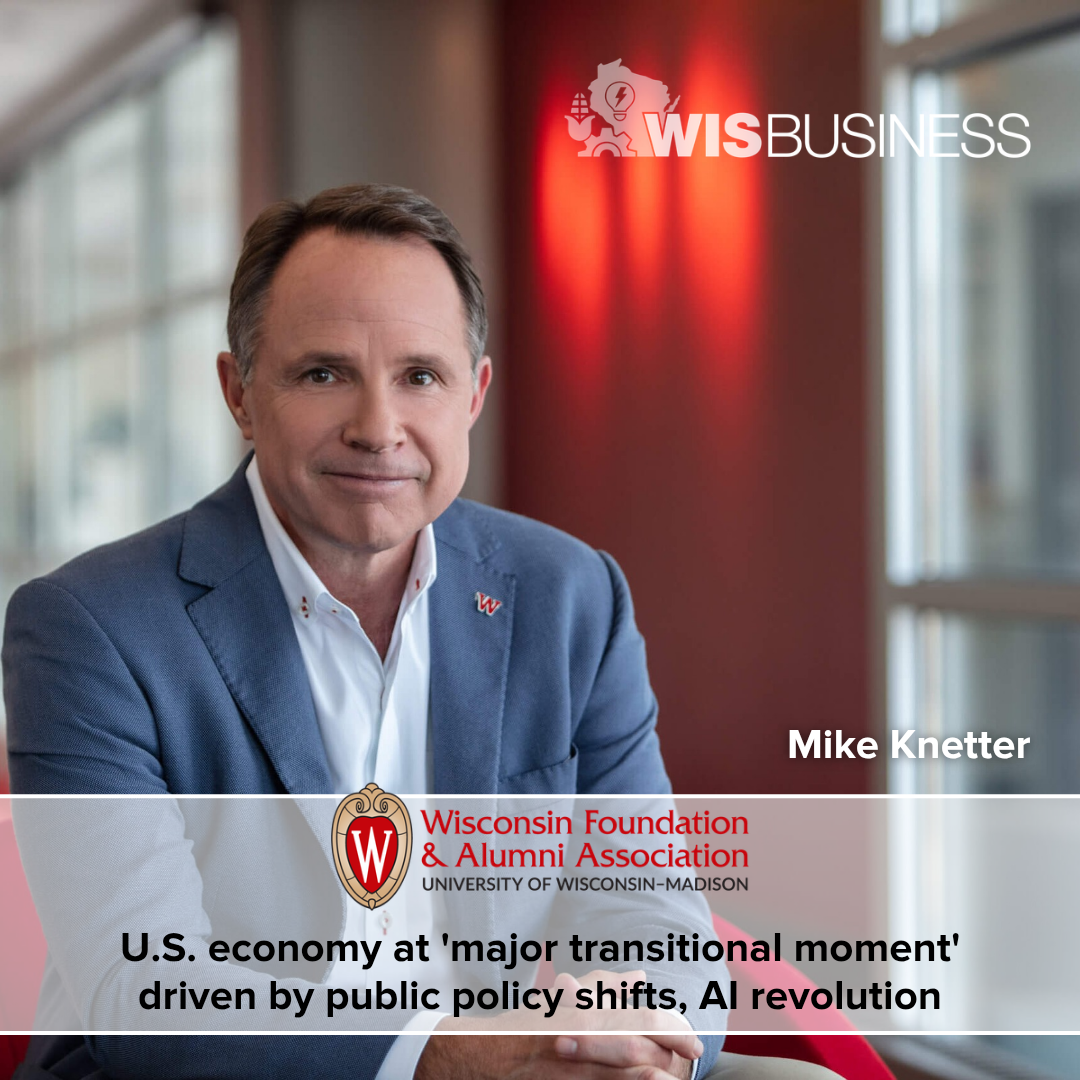
The U.S. economy is at a “major transitional moment” shaped by rapid public policy change and a technological revolution around AI, a Wisconsin economist says.
Mike Knetter is the senior advisor for investments and business development at the Wisconsin Foundation & Alumni Association, and the former dean of the Wisconsin School of Business.
Speaking during a recent meeting of the Rotary Club of Milwaukee, Knetter said artificial intelligence may be affecting the economy “in a bigger and faster way” than other technologies ever have.
“The other thing that’s moving really fast is the current administration,” he said last week. “They’ve implemented many major policy shifts, mainly through executive actions, which allows them to move with speed. But I will argue today, do erode a lot of the foundations of American capitalism.”
While he doesn’t expect major impacts to economic performance in the short-term from these actions, Knetter predicted the federal government’s interventions will start to take a toll in the coming decades. He drew a comparison between the Trump administration and other countries where the government has had “too big a role” in resource allocation.
“Even Soviet five-year plans worked pretty well for a while,” he said, adding “over the long run, you don’t want one person deciding where to invest your capital, and there’s a lot more of that going on today than makes me comfortable.”
He argued the outsized impact of AI on the economy is masking some impacts of the administration’s America first policies. A group of the 41 top AI-related companies — dubbed “the blob” by some — have made up 75% of S&P 500 returns and 80% of earnings growth since ChatGPT launched in late 2022, according to Knetter.
“We just haven’t seen anything like this, where such a small group of firms has such a big impact,” he said.
At the same time, eight of the 10 largest U.S. companies by market capitalization didn’t exist 50 years ago, Knetter noted, calling it “highly unusual” for such a mature, developed economy. By comparison, he pointed to Germany, where none of the top 10 firms are that young.
“That’s normal, actually. That’s what the world is like in most places,” he said. “And we are demonstrably different … Because we are on the technological frontier, we’re not borrowing technology from anyone else to figure out how to build a better mousetrap. We have to invent it and deploy it to stay ahead.”
While U.S. tech sector development continues, it’s taking place against a backdrop of shaken international trade norms, as the Trump administration has targeted allies and adversaries alike with tariffs and other pressure. Knetter called it “a mess,” arguing it’s resulting in misdirected efforts in the political realm at the expense of innovation.
And though he said the administration’s efforts to cut taxes and reduce regulations will likely boost economic activity, he argued trade frictions reduce specialization and division of labor, dragging down growth and driving up inflation.
Meanwhile, new barriers to immigration will reduce the quality and quantity of the labor force, he said. He also claimed the “erosion” of independence for the Federal Reserve will likely increase long-term inflation and weaken the dollar. And he said attacks on research funding and foreign students will “reduce human capital” and related innovation.
“Make no mistake, these policies will have economic consequences,” he said.
Watch the video.