
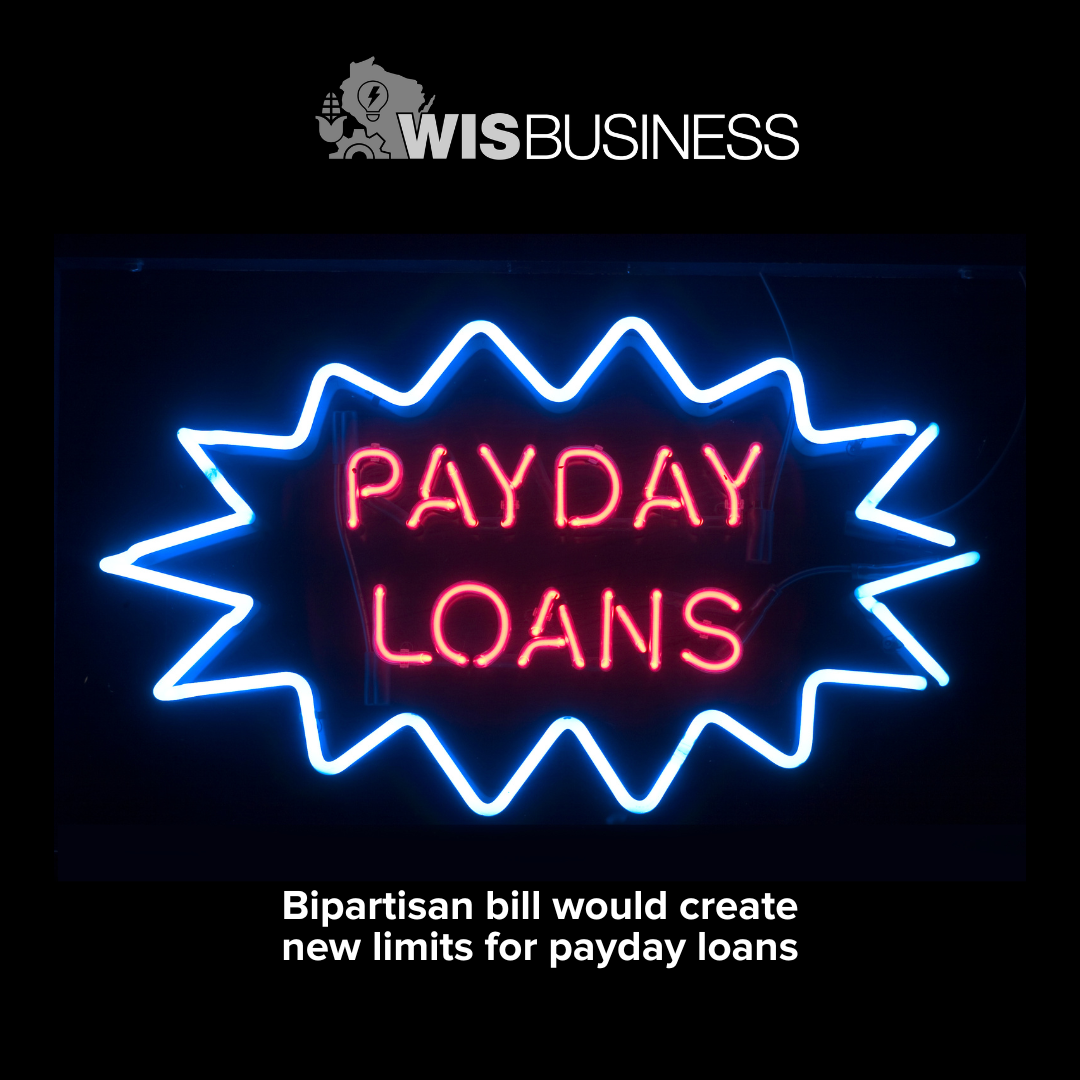
Bipartisan legislation would cap the interest payday lenders may charge at 36%, among other changes for these loans that bill authors say have “outrageously high” interest rates.
Reps. Scott Allen, R-Waukesha, and Amaad Rivera-Wagner, D-Green Bay, along with GOP Sen. Andre Jacque of New Franken, recently sent a co-sponsorship memo to other lawmakers on two bills: LRB-2249 and LRB-4308.
They wrote the bills “work together to create a framework for healthy lending” by making various changes to state law surrounding payday loans.
Most of these loans provided by short-term lenders are called “installment loans” under state law, the memo shows. While at least 17 companies in the state already provide these loans with a maximum interest rate of 36%, others short-term lenders charge as much as 850%, the lawmakers note.
Under either piece of legislation being circulated, the annual percentage rate or APR for payday and installment loans would be set at 36% — the same as the federal APR limit for short-term loans being provided to veterans.
“If the Federal government has recognized that an APR above 36% is harmful for veterans then it makes sense to recognize it as adverse for Wisconsinites in general,” lawmakers wrote.
They argue too many state residents are “trapped” in short-term loans with “outrageously high” interest rates.
One of the bills includes various reporting requirements for short-term lending, which authors say will “help provide transparency” in the industry. Under LRB-4309, licensed lenders would have to report the average APR for their loans, as well as the number of loans that were refinanced or led to a money judgment or vehicle repossession.
The other bill, LRB-2249, would redefine the framework for payday loans in state law while adding a number of restrictions and requirements.
Under the legislation, payday lenders would have to have a “reasonable underwriting process” for verifying the applicant’s ability to repay the loan, according to the Legislative Reference Bureau. And they could’t make a loan that “exceeds the amount the applicant is capable of repaying” based on that underwriting process, or the maximum amount allowed by current law.
Lenders would also have to clearly disclose to applicants the payment plan and the amount of interest to be paid over the course of the loan, as well as notifying applicants about financial literacy courses made available under the Department of Financial Institutions.
Bill authors say limiting payday loans to no more than six months — with equal payments including some going toward the principal — would allow them to continue “playing a unique role in the market” while also allowing borrowers to consistently pay down their debt.
They argue these changes would allow loan recipients to free themselves from “a poverty trap” and make better financial decisions.
“We know that financial literacy is key to getting people out of poverty,” they wrote.
The co-sponsorship deadline is Thursday at noon.
See the memo.