

By Brian E. Clark for WisBusiness.com
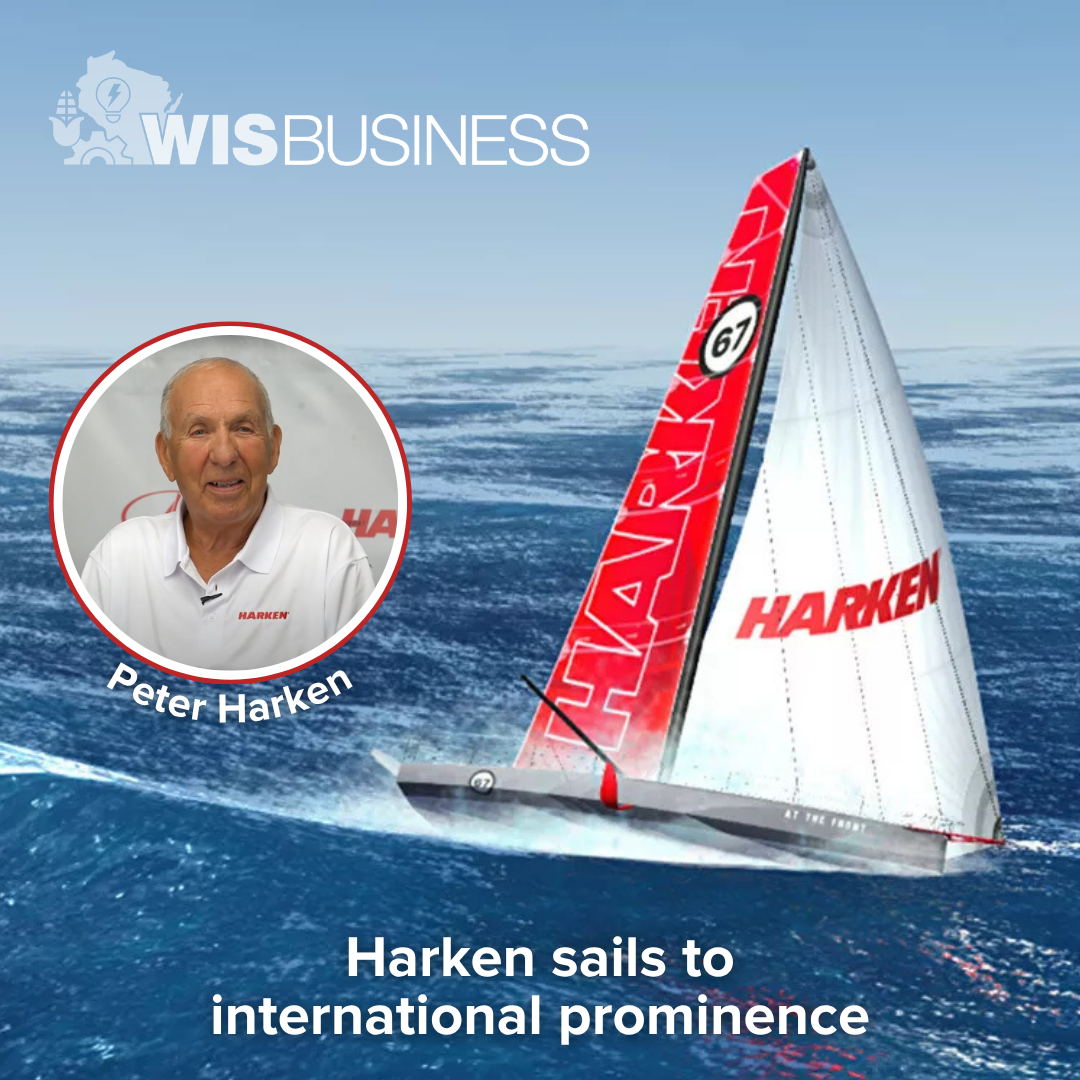
Sailing pioneer Peter Harken never saw a sailboat or piece of hardware he didn’t think he could improve.
“Peter has always looked at the world differently, forever trying to figure out how to fix stuff and make it better,” said Bill Goggins, CEO of Harken, Inc.
And Peter’s still doing that,” added Goggins, an avid sailor himself.
The Pewaukee-based sailing gear company was started by Peter and his brother, Olaf, more than 50 years ago in a run-down garage in Waukesha. Today, the signature Wisconsin company with 400 worldwide workers is branching into safety gear.
Olaf died in 2019, five years after he and Peter were inducted into the National Sailing Hall of Fame for their contributions to the sport.
The pair were lauded for revolutionizing yachting hardware with their lightweight plastic ball-bearing blocks, the nautical term for pulleys.
They were also praised for manufacturing high-performance winches and other equipment for boats – including those on scores of Wisconsin lakes – as well as for dinghies, Olympic-class sailboats and America’s Cup yachts, which can cost $10 million and more. On some of those high-end boats, you might find the Harken 70 Hydraulic 3-speech Performa winch, which retails for roughly $15,255.
“Olaf and his brother Peter revolutionized the sport of sailing with their innovative deck hardware,” Professional Boatbuilder Magazine editorialized after Olaf died.
Peter Stark, co-president of the National Sailing Hall of Fame in Newport, Rhode Island, called the Harken brothers “trailblazers on and off the water; not only as sailors, but as engineers.”
Stark said the brothers developed a well-earned reputation for innovation and vision.
“Their equipment is some of the best anywhere. And they’re beloved throughout the sailing community for their expertise, their humor and their generosity to the sport,” he said.
This writer has seen and used Harken gear on sailboats from Lake Superior’s Apostle Islands to the Caribbean to Greece and even Sweden’s Lake Vännern, the largest lake in the European Union.
The Harken story begins on the island of Sumatra in the late 1930s, where Peter and Olaf were born to a Swedish mother, Ulla, and their Dutch father, Joe, who represented Caterpillar in Indonesia.
“They had a very normal, All-American childhood,” quipped Goggins, who joined Harken in 1999. “Ultimately, they ended up in a Wisconsin farm field making equipment for many ultra-high-net-worth Grand Prix sailors of the world.”
When Japanese forces attacked in January of 1942, the boys and their mother escaped from what was then known as the Dutch East Indies (now Indonesia) to Borneo and then New Zealand. But Joe stayed behind as part of the resistance. He was captured and spent five years in a POW camp.
The family was reunited in 1946 and, after some time in the United States, moved to the Philippines, where Joe worked for Caterpillar again and the boys learned to sail. They were top athletes at the International School in Manila.
Both got college swimming scholarships. Olaf attended Georgia Tech, where he majored in industrial engineering. Peter went to UW-Madison, where he started out in engineering but belatedly graduated with a degree in international economics.
An admittedly indifferent student, Peter joined the Hoofers outdoor recreation club soon after his arrival at the university.
Once in Madison, he continued to sail and race year-round on Lake Mendota and other bodies of water (including on ice during the winter), learned to canoe whitewater rivers and started rock climbing, among other outdoor pursuits.
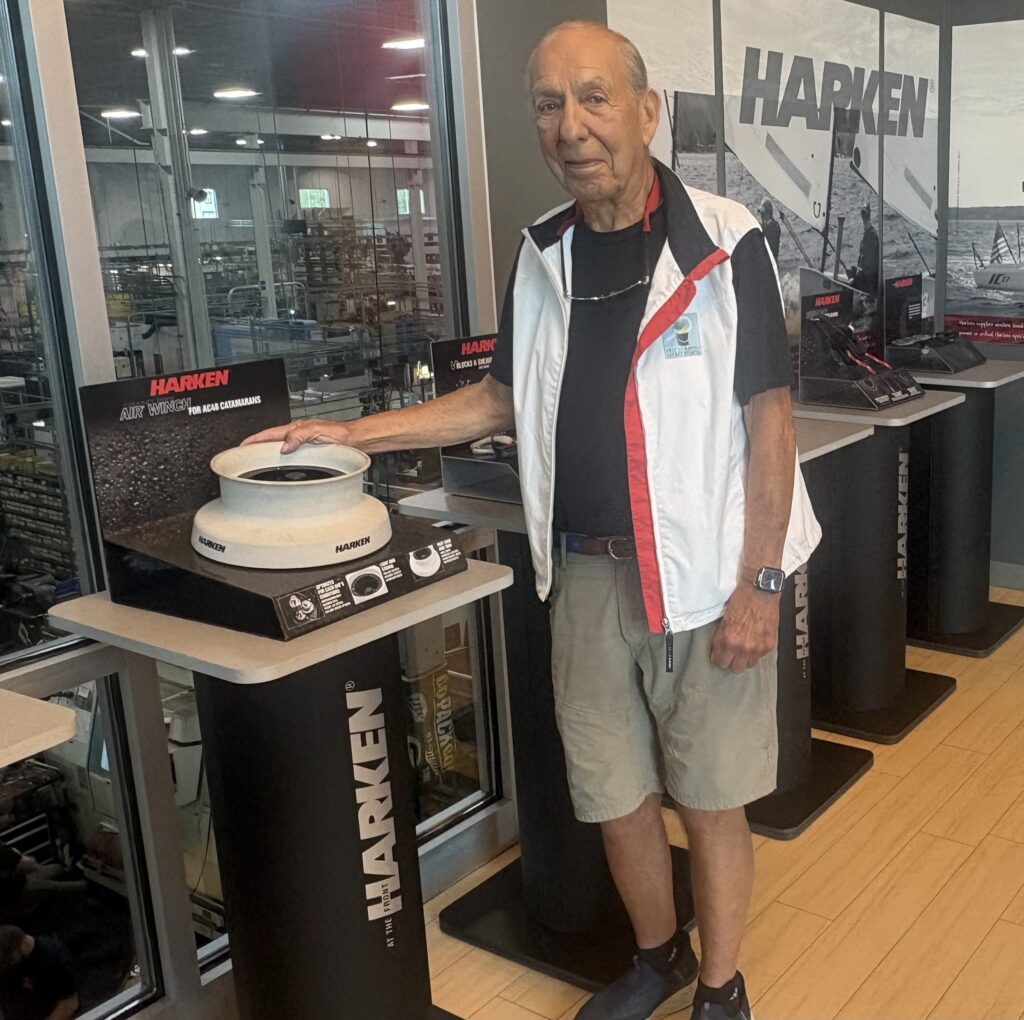
“Hoofers is where I spent a lot of my ‘so-called’ academic career,” chuckled Harken, 89, during a recent interview at the company’s headquarters off Blue Mound Road in Pewaukee.
The building features a 145,000-square-foot ground floor dedicated to manufacturing, assembly, shipping and warehousing. The second floor includes 30,000 square feet of office space for engineering, marketing and customer service. The campus sits on a 26-acre plot which features a large holding pond and preserved wetlands.
Peter also took time off to spend one winter as a ski bum in Aspen, Colorado, hanging out with the U.S. and Austrian ski teams, thoroughly enjoying himself and “studying recreation.”
Before heading off to Colorado, Peter said he gave his father some “bullsh*t story about why it was so important for me to go to Aspen to learn about winter sports. Didn’t work.”
After squandering his parents’ money on skiing, sailing, young women and other non-academic adventures, Peter said his father pulled the plug and told him: “That’s it. You’re on your own. I’m done paying for your playing.”
To finance his education after his return to Wisconsin, Peter worked part-time at Gilson Medical Electronics in Middleton, staying after hours to design and build his own sailing hardware for his E-Scow sailboat and iceboats.
He also made improvements to the Hoofer “Tech” dinghies, which are still in use and were modeled after Massachusetts Institute of Technology boats.
Peter, who was “commodore” of the Hoofers Sailing Club in 1967, modified the standard MIT design to better fit Lake Mendota. He expanded the bow air tank, rounded off the gunwales and deepened the transom.
These changes created extra flotation and allowed a capsized dinghy to right itself mostly dry, resulting in a heavier, durable training boat that has served the club for nearly 60 years. They are officially known as “Badger Techs.”
While working at his Gilson bench, he said he was amazed when some plastic ball bearings he’d purchased from a New Jersey company rolled off, hit the floor and bounced quite high. He immediately thought they could be used to upgrade sailboat pulleys.
“The less mass, the faster things accelerate,” he said. “That’s what blocks do on a boat — stop and start all the time.”
So he replaced the stainless steel needle bearings in his pulleys with quarter-inch nylon ball bearings.
“I went home that evening and sketched up a block with the balls in it,” he said. “Then I made them the next day at Gilson.”
At first, he built them for his own boats, using the vessels as test platforms for his designs.
When opponents saw his sails releasing faster and his equipment working better than theirs, word about the “black blocks (pulleys) with white plastic balls” spread.
“I didn’t propose to sell them elsewhere, at first,” he said. “But then they started to catch on. And here we are.”
On breaks at Georgia Tech in Atlanta, Olaf drove the 700 miles back to Wisconsin to help his brother. After graduation, Olaf served in the Navy as an officer on a destroyer in the North Pacific.
Upon Olaf’s return, the brothers and several friends started a short-lived boat building/sailmaking/ball bearing block business called Scanda. That first attempt in the business world failed.
Olaf then left Wisconsin for an engineering job in New York City. But he returned to Wisconsin in 1968 to help Peter with a new company — Vanguard — making sailboats for college teams and clubs.
They also continued making their homemade ball-bearing pulleys and within a few years adopted the moniker Harken Yacht Equipment after selling the boat line, which had earned national and international awards.
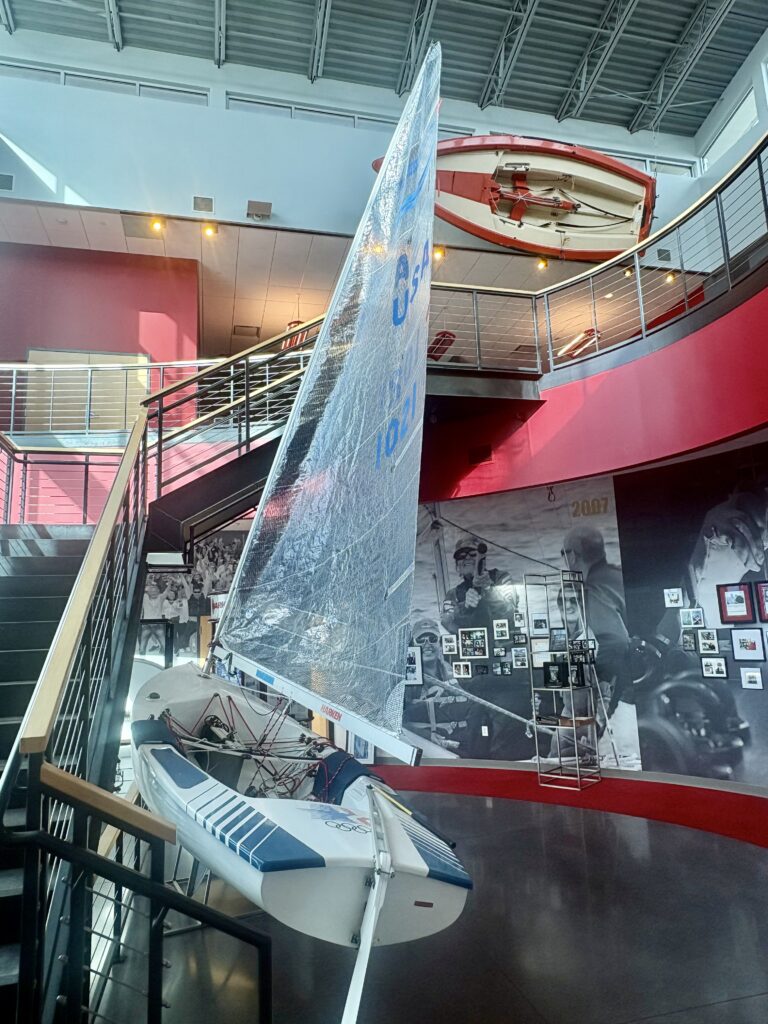
The Harken/Vanguard Finn 470 and 420 sailboats dominated the Sailing World Championships and the Olympics from the 1970s to the mid-1980s.
One of those boats hangs in the lobby of the company headquarters.
In 1986, the brothers sold Vanguard and made the decision to focus entirely on hardware as Harken Inc., growing it into a world leader in performance sailing gear, America’s Cup equipment, and — in recent years — industrial and outdoor safety rescue systems.
Early on, Peter recalled, they fortuitously put their prototype blocks into a cigar box and showed them to Gary Comer, an old friend and founder of Lands’ End, which was then a marine mail-order business.
Founded in 1963 in Chicago, the company shifted its focus from yachting gear to clothing and lifestyle goods by 1977. It relocated to Dodgeville in 1978.
It was Comer, Peter said, who suggested they sell the pulleys under the name Harken rather than Vanguard because rival boat makers wouldn’t want to buy from a competing boat builder.
Comer sold some of these early blocks to Lowell North and Buddy Friedrichs, who were both gold medalists in sailing at the 1968 Olympics.
Oddly, Olaf, with his engineering degree, handled marketing while Peter led the technical side of the business. But it was Art Mitchell, Harkin’s director of operations, who kept the company from going under.
“Art was Peter’s roommate at UW-Madison and kept those guys out of jail in college,” quipped Goggins.
“Later on, when Olaf wanted to go in one direction with something that was visionary and Peter wanted to go in the opposite direction, he’d bring them together. He was the adult in the room and kept the business on track.
“He kept the business performing and was often the only adult in the room. Art was my mentor, and his last title was ‘Corporate Navigator’,” Goggins said.
Peter said he and Olaf got a major boost early on from LeRoy and Al Stippich of Accurate Products, a tool and die maker in Waukesha.
The Stippichs saw themselves in the two young brothers starting out with little money.
When they learned that the Harkens couldn’t afford the expensive injection molds and stamping dies for the full-scale production of their ball bearing blocks, they offered to build the tooling and fabricate the blocks for them.
That agreement, made with an initial handshake, lasted until Harken bought Accurate Products in 2010.
Most of Harken’s gear is manufactured in Wisconsin. But in 1987 the brothers acquired the Italian winch manufacturer Barbarossa.
Harken then integrated and adapted the Italian engineering expertise of Barbarossa’s team. As a result, their lightweight, high-performance aluminum and carbon-fiber winches soon became the dominant industry standard, particularly after proving themselves in elite competitions like the America’s Cup.
Harken continues to make its winches near Lake Como in northern Italy, where it has around 100 employees.
According to company lore, Harken employees celebrated the new alliance by taking Italian lessons. As a result, “Italian-Pewaukanese” became a new language that might be heard next May and July when the 38th America’s Cup takes place off the coast of Naples, Italy.
In 2010, they began building hydraulic pumps for use on deck gear and to adjust sails, including rigid ones that resemble airplane wings and are used mostly on racing catamarans and trimaran sailboats.
In recent years, the company has expanded beyond sailing, launching an industrial safety division, applying its extensive core understanding of manipulating “Rope Under Tension” by forming a new division, Harken Safety & Rescue.
It also purchased several outdoor rescue equipment companies such as Seattle Manufacturing Corp. and Cascade Rescue, which makes litters, stretchers and rescue toboggans used by ski patrols at resorts in Wisconsin and around the nation.
In 2020, the company became employee-owned through an employee stock ownership plan. Harken now has around 220 employees based in the United States and 400 worldwide.
“People sometimes asked me why we didn’t move elsewhere, someplace closer to year-round sailing,” Peter said.
“I told them the reason is our people,” he mused.
“My brother and I lived in a lot of places, including the Philippines. But there’s no one like the folks who live in the Upper Midwest.”
“They’re talented, they’re loyal, hardworking and fun. We decided that this was a good place to start something. It’s certainly not the climate or anything like that.
“It’s really just the people. We just let them run.”