
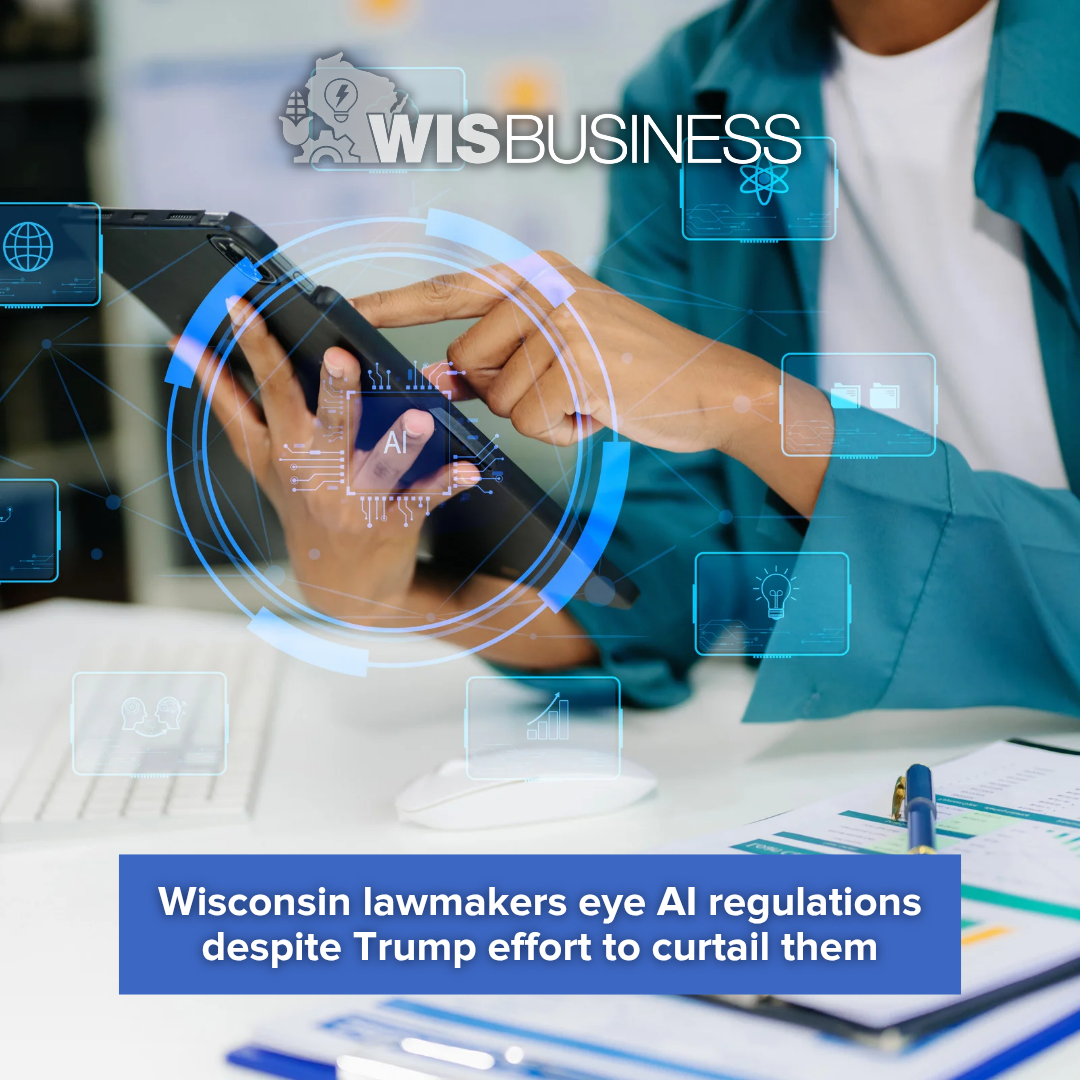
Despite a presidential effort to curtail AI regulations at the state level, Republican lawmakers in Wisconsin see a role for legislation to protect data privacy and improve agency operations with the technology.
Rep. Nate Gustafson, who chairs the Assembly Committee on Science, Technology, and AI, also says he believes in the technology’s potential to help address workforce concerns in Wisconsin.
“We have a massive labor gap. The workforce crisis is still in full swing, if not going to get worse,” the Omro Republican said in a recent interview. “We have a tool now at our disposal that we absolutely need to take advantage of now, rather than sitting around and waiting for individuals to fill these positions.”
But President Donald Trump’s recent executive order targeting state-level AI regulations could complicate the picture, with Dems in Wisconsin condemning the move as harmful and overly restrictive.
“It’s unfortunate that states aren’t allowed to develop solutions that best protect and balance their business interests with important concerns such as the environment and labor,” Rep. Ben DeSmidt, D-Kenosha, said in a statement on Trump’s Dec. 11 order.
Before that order was issued laying out a “national policy framework” for AI, Wisconsin had already passed AI-related legislation. Rep. Adam Neylon, R-Pewaukee, introduced a bill last session requiring disclosures of AI use in political campaign commercials, which he says was one of the first AI laws on the books in Wisconsin.
After reviewing Trump’s executive order, Neylon said the state’s existing AI laws don’t seem to be threatened by it.
“Our laws do not block or stifle innovation or the growth of AI,” he said in a statement. “Instead, they establish reasonable, targeted guardrails that allow innovation to continue while ensuring accountability and public trust.”
Looking ahead, Gustafson says one of his top priorities in the AI policy space is protecting data privacy for consumers and constituents. He raised the issue of widely used AI platforms drawing on sensitive data, adding he wants to find ways to mitigate related risk.
He’s also interested in exploring how to support the work of state agencies with AI tools, to help boost productivity without having to add more staff positions.
“That’s I think an angle that we’re going to continue to look for,” he said. “I think some other opportunities we’re going to be looking for, especially through the lens of workforce development, what are our colleges and universities doing regarding upskilling, or what are our businesses doing.”
He added establishing public-private partnerships to provide resources for such efforts would “make sure those who are still in the workforce have what they need to continue to be productive for us.”
In a separate interview, Neylon echoed Gustafson’s emphasis on protecting private data, noting health information in particular should be shielded from misuse by AI. He noted numerous private data protections are guaranteed through companies’ policies, but said no state laws currently exist to ensure that.
“We’re looking at … what are some of the best practices in the AI space, and potentially codifying it to make sure there’s like actual statute to back up those protections,” Neylon said. “So if a company changes their policies around privacy protection, that it doesn’t open up, you know, people to be more vulnerable to fraud.”
Even as he and others eye potential AI issues to address with legislation, Gustafson said he’s taking a “wait, don’t regulate” approach in the Assembly’s AI committee. He warned that overregulation of the technology could hinder future development, and cause Wisconsin and the country overall to fall behind.
“We shouldn’t rush to regulate, and that’s where, if there’s low-hanging fruit, that just makes sense … great, we can address those,” Gustafson said. “But we shouldn’t have a broad, sweeping lockdown of how AI is developed, who’s using it, how they’re using it, unless it obviously doesn’t comply with state law.”
Neylon called it a “delicate balance” to avoid creating a confusing patchwork of regulations on AI while preserving data privacy and protecting people.
“When you look at the innovations in this space, I mean, they’re happening rapidly and in ways that are kind of unforeseen,” he said. “So we want to be careful not to put a lot of rules and red tape around AI, and look at maybe the focus being, how can we make sure consumers are protected.”
Meanwhile, Trump’s AI order declares U.S. companies “must be free to innovate without cumbersome regulation” and “excessive” state laws on the technology stand in the way.
It says establishing 50 different regulatory regimes on AI would make compliance difficult, especially for startups. And the order argues states are using these laws to “embed ideological bias” into AI models, and in some cases, overstep by seeking to regulate beyond state borders.
“My Administration must act with the Congress to ensure that there is a minimally burdensome national standard — not 50 discordant State ones,” Trump wrote. “The resulting framework must forbid State laws that conflict with the policy set forth in this order.”
While DeSmidt of Kenosha — also on the Assembly’s AI committee — slammed Trump’s “one-size-fits-all approach” and argued Wisconsin knows how to regulate itself, Rep. Randy Udell said the order also threatens federal broadband expansion funding for states.
“For Wisconsin, this means losing over $363 million of our federal $1.06 billion Broadband Equity, Access, and Deployment (BEAD) funding,” the Fitchburg Dem said in a statement. “We need these funds to improve internet access for rural and underserved families across Wisconsin. Withholding these Congressionally-allocated funds is unconstitutional and harms working families.”
Neylon said he agrees with Trump that AI and emerging technologies do “ultimately require a federal framework” as they don’t stop at state lines.
“However, it would be [a] mistake to penalize states that acted swiftly and decisively to protect their residents while we wait for Congress and the Senate to develop clear, concrete nationwide AI policies,” he said. “Wisconsin’s approach demonstrates that it is possible to both protect the public and foster innovation and those efforts should be supported as we move toward a comprehensive federal solution.”