
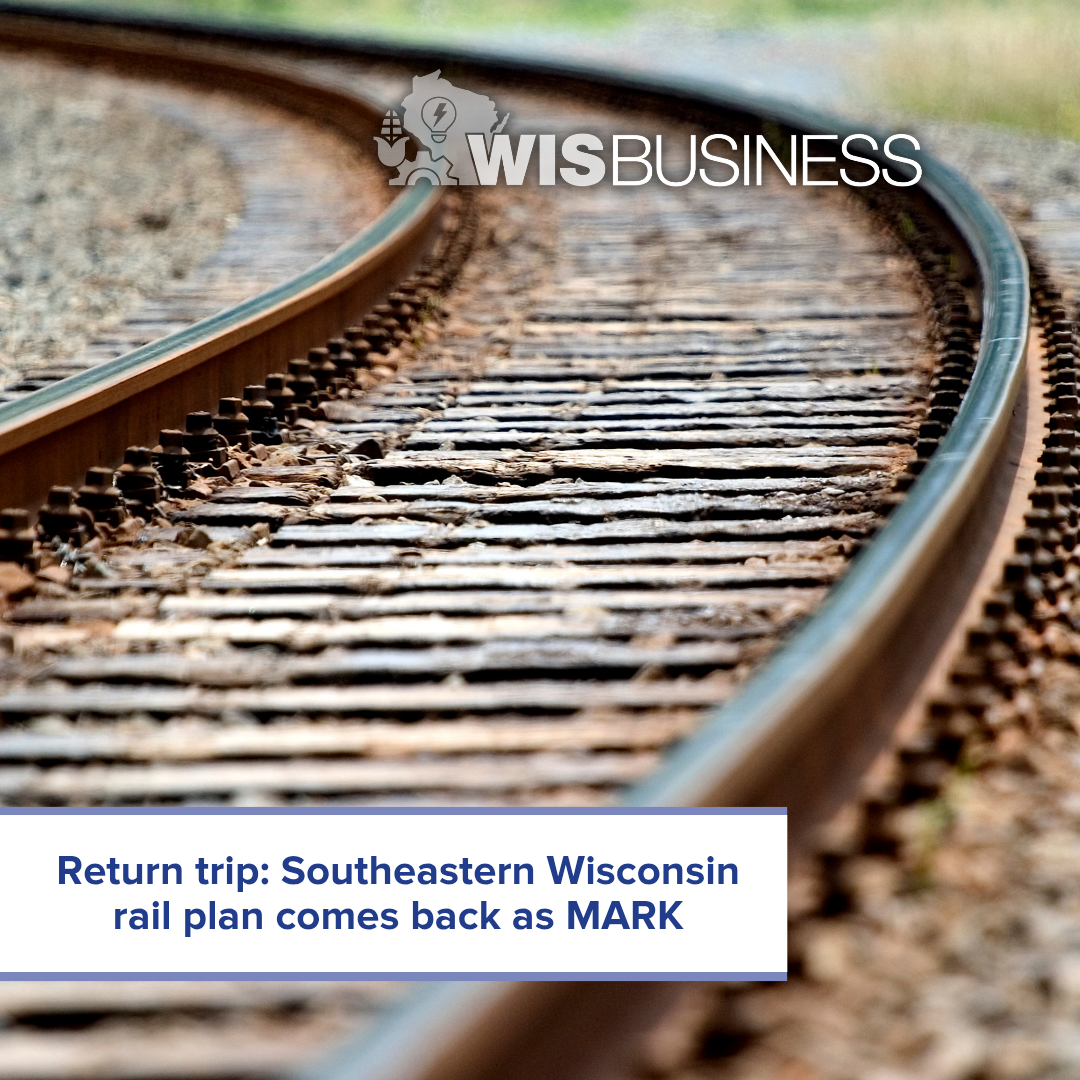
A new effort to connect Milwaukee to Racine and Kenosha by train would take the “commuter” out of commuter rail and keep going all the way to Chicago.
The seemingly defunct KRM plan has been resurrected with a new name, a new approach and a new governing structure, borrowing from the playbook that western Wisconsin rail advocates are using to push for passenger trains linking Eau Claire to the Twin Cities.
Before it was dismantled by the Republican-led Legislature, the former Southeastern Regional Transit Authority was planning the KRM (for Kenosha-Racine-Milwaukee) route as a commuter rail line from Kenosha to Racine and downtown Milwaukee, with stops in five other communities and on Milwaukee’s south side. Passengers would have been able to transfer to the Chicago area’s Metra commuter trains at Kenosha, now the northernmost Metra station.
By contrast, the new MARK Rail Commission is focusing on an intercity passenger rail line with downtown stations in Milwaukee, Racine, Kenosha and Chicago. Other stops in Wisconsin or Illinois might be considered as well, said Milwaukee Ald. Bob Bauman, the commission’s secretary-treasurer.
While commuter rail systems like Metra can serve numerous communities and neighborhoods within a metropolitan area, intercity rail lines like Amtrak’s Chicago-to-Milwaukee Hiawatha stop at fewer stations and travel longer distances at higher speeds. Between downtown Milwaukee and downtown Chicago, the Hiawatha stops at Milwaukee’s Mitchell International Airport, Sturtevant and Glenview, Illinois, bypassing Racine and Kenosha.
Bauman said he expected the MARK trains would “compete very successfully” against the Hiawatha, particularly for passengers interested in intermediate destinations.
He added the Hiawatha would likely remain the preferred option for travel between downtown Milwaukee and downtown Chicago.
Amtrak spokesman Marc Magliari replied, “We’re not going to speculate on a plan that has not been produced.” He noted that a later stage of the federally required study process would flesh out details on stations, speed and frequency of trips, which would determine whether the MARK service would be classified as intercity or commuter rail.
The Chippewa-St. Croix Rail Commission also is looking at intercity passenger rail for the Eau Claire-Twin Cities route, with intermediate stops in Hudson, Menomonie and other communities.
While Amtrak runs almost all intercity passenger rail lines in the U.S., both the MARK (Milwaukee Area-Racine-Kenosha) and Chippewa-St. Croix commissions are open to other operators.
Bauman strongly favors Metra for MARK rail. Metra has agreed to assist in planning and coordination for the southeastern Wisconsin route, but that deal neither commits Metra to operate the service nor rules it out.
Although Metra has operated only commuter trains until now, the Illinois Department of Transportation has picked it to run a new intercity rail line from Chicago to Rockford, Illinois, starting in 2027. Those trains would not stop between downtown Chicago and Elgin, Illinois, now the westernmost Metra station, meaning anyone who wants to get on or off in another western suburb would have to transfer to or from a Metra commuter train at Elgin.
During KRM planning, officials questioned whether an Illinois taxpayer-funded agency like Metra could operate deep into Wisconsin. Metra’s only interstate partnership is with the Northern Indiana Commuter Transportation District, a regional transit authority that runs the South Shore Line from South Bend, Indiana, to downtown Chicago.
The South Shore Line — the last of the electric interurban trains that once ran throughout the Milwaukee area — shares Illinois tracks with Metra’s Electric Line and stops at several Illinois stations. But the Indiana trains are barred from carrying passengers from one Illinois destination to another.
Meanwhile, the Eau Claire-to-Twin Cities route could be operated by one of the companies that now contract with regional transit authorities to operate commuter rail lines around the country, according to Scott Rogers, chair of the West Central Wisconsin Rail Coalition. Rogers is also senior director of governmental affairs for the Eau Claire Area Chamber of Commerce.
Neither the MARK commission nor its western Wisconsin counterpart are regional transit authorities. GOP Assembly Speaker Robin Vos, a diehard KRM opponent, stopped the earlier rail plan by pushing through legislation to abolish all regional transit authorities statewide.
But local governments can still partner for joint services, and that’s what happened in both of these cases. A group of west central Wisconsin cities and counties, led by Eau Claire County, signed an intergovernmental cooperation agreement to form the Chippewa-St. Croix commission in 2021. Under Racine’s leadership, the cities of Milwaukee, Racine and Kenosha signed a similar pact to create the MARK commission, which elected Racine Mayor Cory Mason as its chair at its first meeting Dec. 5.
This structure doesn’t allow the rail commissions to levy taxes. That’s not a problem in the study stages, which are largely funded by federal planning grants, but officials would need to find some funding mechanism to cover construction and operating costs of any routes that are eventually established, Bauman said. Fares alone cannot pay for any form of passenger rail without public subsidies, he noted.
Opponents warned that the project could require new local taxes when the Kenosha County Board voted, 15-7, to support the study in August 2024, before it took on the MARK name. Conservative Supervisor Erin Decker failed in an attempt to call a referendum on the issue, with study backers arguing that such a vote would be premature before the study has estimated the project’s cost and recommended how to pay for it. County Executive Samantha Kerkman cited the lack of a referendum in explaining why she would neither sign nor veto the resolution.
“A countywide referendum would serve to inform Kenosha County taxpayers of costs associated with any potential KRM construction and operational costs once determined by the study,” wrote Kerkman, a former GOP lawmaker. “As Kenosha County executive, I will not sign any future resolution in support of a KRM rail project without a countywide referendum that informs residents of the funding mechanisms that may affect their pocketbooks.”
Kerkman also noted that the county would not have a seat on the study commission, which consists of representatives of the three cities. She did not respond to a request for comment on the latest developments.
“If the political will exists to make this work, it will work,” Bauman said. “If not, it won’t. … If Robin Vos is still the speaker (of the Assembly) going forward, there won’t be a MARK.”
Vos did not respond to requests for comment. But Sen. Van Waangaard, R-Racine, “opposes KRM/MARK passenger rail if it is taxpayer-funded,” said Waangaard’s chief of staff, Scott Kelly. “It was a bad idea … when it was first brought up, and it is still a bad idea today.”
Waangaard was “less opposed” to a private company’s version of the KRM plan, Kelly said. Two private companies have floated commuter rail plans, and one of them, Wisconsin Transit and Realty Group, applied in 2022 for federal funding through the Wisconsin Department of Transportation with the understanding that no state or local tax dollars would be used. However, WisDOT withdrew that application after the company lost a foreign investor in the wake of Russia’s invasion of Ukraine.
Different trains on different tracks
Nationwide, intercity passenger rail is booming, while commuter rail has faced struggles in the wake of the COVID-19 pandemic.
Amtrak has set ridership records for two federal fiscal years in a row. Contributing to that growth was the new Borealis route from Chicago and Milwaukee to St. Paul. From its May 2024 inception through November 2025, the Borealis carried 337,634 passengers on its single daily round trip, according to Amtrak and WisDOT.
But public transit systems have not fared as well since the pandemic disrupted commuting patterns and energized the work-from-home movement. Those trends took a higher toll on rail transit, which is favored by office workers, than on buses, which carry more blue-collar workers, according to a May 2025 report from the American Public Transportation Association. By December 2024, commuter rail ridership had rebounded to only 70% of pre-pandemic levels, compared with 86% for buses, 76% for light rail systems like the Minneapolis-St. Paul Metro and 71% for heavy rail subway and elevated train systems like Chicago’s L, the report said.
Hardest hit was the Twin Cities’ Northstar, the only Midwestern commuter rail line outside the Chicago area. Ridership plunged 95% during the pandemic and never regained much ground. The 16-year-old route will be replaced by bus service after its trains carry Minnesota Vikings fans back from the team’s season-ending home game against the Green Bay Packers on Jan. 4.
Bauman and Rogers said they didn’t consider Northstar’s collapse to be a cautionary note for the MARK and Eau Claire-to-Twin Cities plans. They said Northstar failed partly because it didn’t go far enough, stopping in the outer suburbs of Minneapolis instead of continuing to St. Cloud, Minn. Rogers also cited Northstar’s limited schedule. On weekdays, it operates only during morning and evening rush hours, with no midday options for workers on flexible schedules, and on weekends it runs only for special events.
The Eau Claire-to-Twin Cities route is one of seven Wisconsin intercity passenger rail projects that received $500,000 grants from the Federal Railroad Administration’s Corridor Identification program to kick off their studies. Racine received a separate $5 million federal grant to plan the MARK line, and the MARK commission voted to apply for Corridor ID funding as well.
Also under study are:
- Adding up to three more round trips to the Hiawatha. The line ran seven daily round trips until one was converted to the Borealis and extended to St. Paul along the route used by Amtrak’s long-distance Empire Builder. Lisa Stern, WisDOT chief of railroads and harbors, has said another Hiawatha round trip could start as soon as improvements are done at the Milwaukee airport station. WisDOT expects to complete that project by fall 2026, but has not set a timeline for adding another Hiawatha trip, a spokesperson said.
- Extending the Hiawatha to Madison, and eventually to the Twin Cities by way of Eau Claire. When Democrat Jim Doyle was governor of Wisconsin, the federal government committed $810 million to fully fund construction of a 110-mph Milwaukee-to-Madison route, a project that would have included upgrading the Hiawatha with more trips, improved tracks and new trains. But the feds yanked the cash after Republican Gov.-elect Scott Walker vowed not to spend it on the rail project. In the current study of 79-mph service, Madison has picked a downtown site near Lake Monona for a new station, with a site next to the new Madison Public Market as the second choice. In response, Walker recently posted on social media, “This is a dumb idea,” arguing it’s quicker and cheaper to drive a car between Madison and Milwaukee.
- Adding another round trip to the Borealis, which has exceeded ridership expectations. However, some of that ridership came at the expense of the Hiawatha, whose ridership dipped 5% in the federal fiscal year that ended Sept. 30, 2025.
- Extending the Hiawatha to Green Bay. If this route is established, state law would require intermediate stops in Appleton, Oshkosh and Fond du Lac.
- Creating the Northern Lights Express, a proposed 90-mph Minneapolis-to-Duluth route with a stop in Superior. The Minnesota Department of Transportation is leading that study.
- Establishing the Big Sky North Coast, a proposed long-distance line that would connect Chicago, Milwaukee and the Twin Cities to the Pacific Northwest on a different route than the Empire Builder, with possible stops in Madison and Eau Claire. That route is under study by Montana’s Big Sky Passenger Rail Authority.
WisDOT is leading the Hiawatha, Borealis, Madison and Green Bay studies. All seven studies were expected to complete their initial phases by Dec. 31, 2025, and must await approval and further funding from the Federal Railroad Administration.
— By Larry Sandler
For WisBusiness.com