

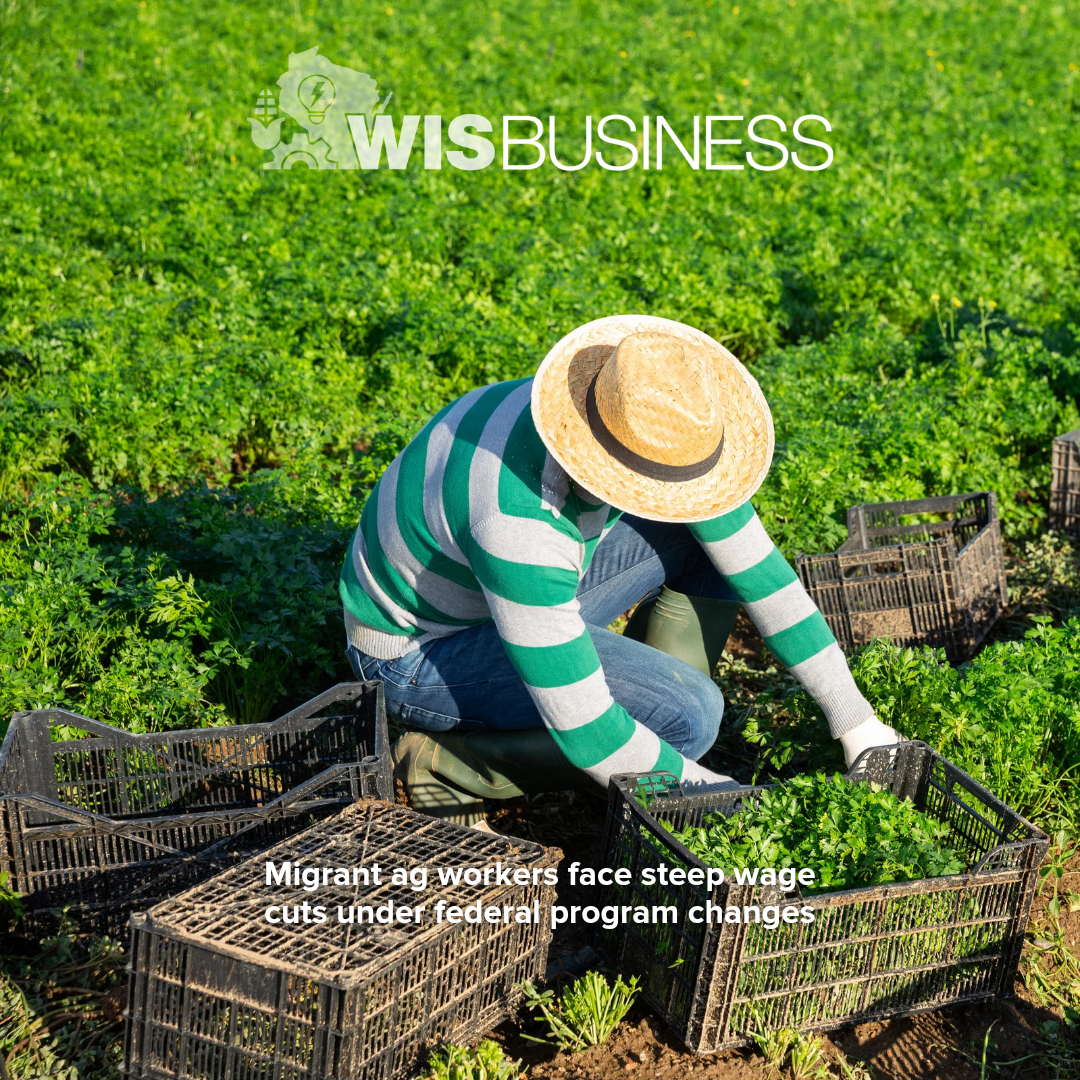
Federal changes to wage rates under the H-2A migrant labor program are expected to lower costs for employers in Wisconsin and elsewhere, though advocates are raising concerns about the impact on workers whose pay will drop dramatically.
Most of the workers coming to Wisconsin under the program could see their wages slashed by more than a third under new rules released late last year by federal officials.
“Certainly it’s going to be difficult,” United Migrant Opportunity Services President and CEO Jose Martinez said in a recent interview, adding “under this new system, it’s going to be harder for them to make ends meet” due to the lower wages.
The H-2A program allows agricultural employers to bring in workers from outside the United States to fill temporary positions, supplementing the domestic workforce. In Wisconsin, these laborers typically work at crop farms, plant nurseries and greenhouses doing seasonal work.
The state has seen a largely steady increase in the number of H-2A worker certifications over the past dozen years, rising from 176 in 2013 to 3,030 in 2025, according to figures from the state Department of Workforce Development.
This shift comes as Wisconsin’s ag workforce has changed significantly, with young farm family members more likely to look elsewhere for employment, rather than working at home. Tyler Wenzlaff, director of national affairs for the Wisconsin Farm Bureau Federation, says it used to be “pretty common” for family or local high schoolers to provide most of the labor on a farm.
“Today, that model just doesn’t work anymore,” Wenzlaff told WisBusiness.com. “Young people, high school students are choosing different part-time jobs because they pay similarly and they’re a lot less work. As a result, farms have had to adapt, and they’re turning to a more diverse, but still dedicated workforce that includes many immigrants.”
Against this backdrop of rising reliance on the H-2A program, the U.S. Department of Labor last year rolled out changes to the program’s minimum wage policy, establishing a new two-tier system with different pay based on skill level.
In justifying the new rules, the federal agency wrote that employers in the U.S. ag sector are facing “a structural, not cyclical, workforce crisis” driven in part by the lack of an available, legal workforce that can adjust to labor demand changes. The DOL also references the decline of the mobile illegal immigrant workforce, noting illegal border crossings have fallen by 93% from a recent peak.
“The near total cessation of the inflow of illegal aliens combined with the lack of an available legal workforce, results in significant disruptions to production costs and threatening the stability of domestic food production and prices for U.S consumers,” the agency wrote.
Previously, one single Adverse Effect Wage Rate applied for all H-2A workers — in Wisconsin, that was $18.15 per hour. Under the new framework, employers are required to pay at least $13.29 for the lower-tier Skill Level 1 and $18.22 for the Skill Level 2, reserved for those with specialized training or experience.
But another change to the program allows employers to essentially deduct a set amount for providing required non-wage compensation benefits such as housing. This potential reduction in the hourly wage of $1.29 per hour means the new wage rates could be as low as $12 for Skill Level 1 and $16.93 for Skill Level 2 in Wisconsin.
Martinez says as much as 92% of H-2A workers will be paid under the lower tier, based on DOL estimates.
Both the state and federal non-farm minimum wage are $7.25. But employers participating in the H-2A program must comply with the AEWRs outlined in DOL regulations. These higher rates are meant to ensure employing a worker through the program doesn’t “adversely affect” wages and living conditions of domestic workers, according to analysis by the law firm Fisher Phillips.
One employer that brings on dozens of H-2A workers each year, Gumz Farms in Marquette County, expects to save on labor costs as a result of the changes.
This fifth-generation family farm grows corn, beans, mint, carrots, onions and potatoes, and packages some crops for commercial sale. In recent years, the farm has brought on about 42 H-2A workers per year to weed fields, help with harvesting and crop storage, package products and more.
Charles Poches, the business manager for Gumz Farms and a member of the Governor’s Council on Migrant Labor, acknowledged the farm will be saving money due to the lower wage rates, though he says “there’s still a little bit of ambiguity” about how exactly the new pay structure will work.
“I’m still working through what’s a level one employee, what’s a level two and the commensurate pay associated with that,” he said.
At the same time, he noted the substantial pay cut for those workers who fall under the lower tier.
“We’re still trying to determine where our people fall,” he said. “Going from $18.15 last year down to $12 an hour is quite a jump, and trying to balance what is economically sound for the farm with making sure we still have people in Mexico who are engaged in employment and wanting to come across.”
When asked about the potential for these changes making it harder to hire workers under H-2A, Poches took a cautious stance and said he’s waiting to see how other employers are dealing with this to better understand the path ahead. He noted Gumz Farms brings these laborers on later than other employers, in the second week of June. Others typically start in April or May.
“We’ve not necessarily started the conversation with the people we employed last year … I think for so many years we’ve gotten used to just doing it the way we have, this throws a bit of a wrench into the question of how do we address this moving forward,” he said.
The Farm Bureau’s Wenzlaff said members in Wisconsin that use the program “have not signaled that these wage changes have been a detriment to recruitment,” at least so far.
Ultimately, Martinez of Milwaukee-based UMOS said he doesn’t expect the wage reductions under H-2A to drive workers away from engaging with the program. The $12 rate is still above what they’d be getting in Mexico, he noted.
But Martinez predicted the wage adjustments will result in a “huge overdependence” on H-2A to get crops harvested. He also said he’s worried about broader ripple effects from the changes to the program, arguing they will “drive down wages” in agriculture for local workers as well.
“That’s not the intended consequence, but it is going to happen, it’s going to drive down the hourly rate for your local workforce,” he said. “When we talk about affordability and decent wages, that’s going to make it even tougher for them. So that’s my biggest fear, that you’re going to start seeing the local workforce displaced as a result.
“I certainly don’t want to see that,” he said. “We want to ensure that we have opportunities for everyone.”
After the DOL issued the rule in October 2025, United Farm Workers of America filed a lawsuit in California seeking a temporary injunction to suspend implementation of the new framework, Martinez noted. U.S. District Judge Kirk Sherriff reportedly said he plans to issue a ruling in the case soon, after a recent federal court hearing was held earlier this month.
Meanwhile, the beginning of Wisconsin’s hiring season for H-2A workers is just around the corner.
“I think the obvious question is, have we seen an impact? Well, not yet … I think time will tell,” Martinez said. “As we get closer and folks get hired and brought on … this is when we will start seeing the full effect of how these new tiers and these wages will begin to pan out.”