

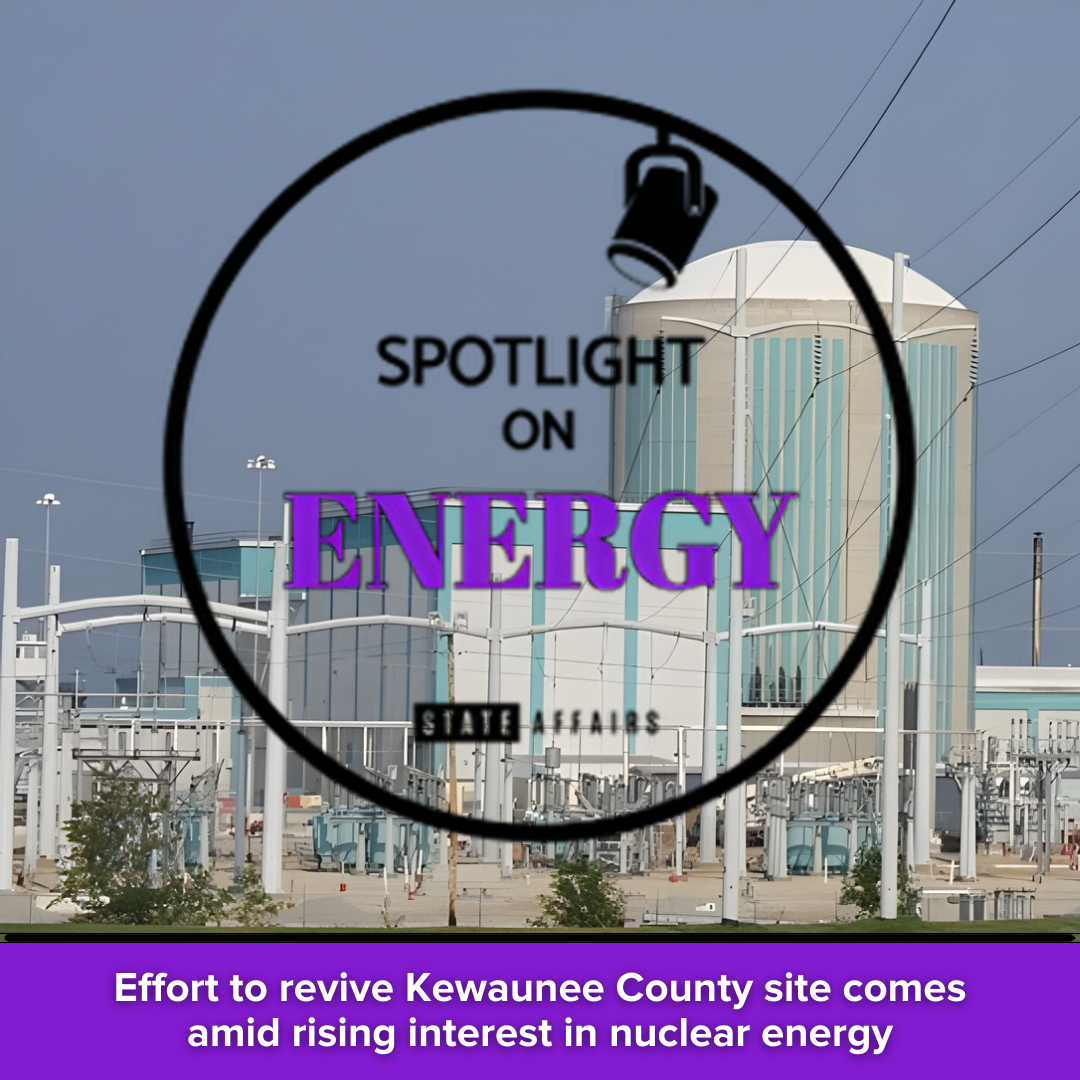
A new effort to rekindle a former nuclear power site in northeastern Wisconsin comes amid growing bipartisan interest around nuclear energy in the state.
One of Wisconsin’s major utilities, WEC Energy Group, is working on the project with Utah-based EnergySolutions. The companies earlier this year announced plans to explore options for new nuclear generation at Kewaunee Power Station on Wisconsin’s northeastern coast. The power station has been offline since the plant was decommissioned in 2013, leaving just one nuclear plant in nearby Two Rivers.
Nuclear power currently makes up about 15% of the state’s energy mix, but advocates are pressing for more.
The Kewaunee announcement follows Democratic Gov. Tony Evers last year signing into law two bills aimed at advancing nuclear energy in the state: one authorizes a nuclear power siting study; and the other creates a Nuclear Power Summit Board. At the same time, other legislation has been proposed to boost various forms of nuclear energy in the state, garnering support from both Republicans and Democrats.
Professor Paul Wilson, who chairs the University of Wisconsin-Madison‘s Department of Nuclear Engineering & Engineering Physics, says “there’s lots of things to recommend” nuclear as an energy source, from the energy density of its fuel to its ability to provide power regardless of the weather – unlike wind and solar.
“If your priority is for a clean, low-emission energy system, there’s a growing recognition across the political spectrum that nuclear energy is a key player in that,” Wilson told WisBusiness.com in a recent interview.
State Rep. Lisa Subeck, D-Madison, says nuclear energy is “a place where we’re finding common ground” in the state Legislature, noting she’s worked with multiple Republican lawmakers on this topic.
“For a long time, there was a lot of fear around nuclear energy, and I think that we’re getting to the point where we’re getting over that fear,” she said in an interview, adding, “nuclear energy provides an opportunity to bring the two parties together.”
Meanwhile, Rep. Shae Sortwell, R-Two Rivers, pointed to a “growing consensus” across the political spectrum that nuclear power needs to play a key role in Wisconsin’s future energy landscape. Energy demand is expected to rise in the years to come due to a growing number of “hyperscale” data centers being built across the state.
Sortwell noted coal is generally a more popular energy source with Republicans in the state, while Democrats are more supportive of wind and solar. Even natural gas comes with environmental baggage due to concerns over fracking. He argued “nuclear power is really your only choice that everyone is okay with.”
Coal and natural gas made up 72% of the state’s electricity generation in 2024, the latest year covered in the U.S. Energy Information’s overview for the state. Another 12% came from renewable resources.
Subeck also stressed the importance of ramping up energy production to meet rising energy needs from data centers and other drivers of demand while balancing that with sustainability concerns.
“Nuclear is a way to grow that addresses the environmental concerns that Democrats have and also meet those growth needs the Republicans are really focused on,” she said.
Added Wilson: “If you built a new nuclear power plant, then we would be getting more of our share of our electricity from nuclear. …There’s no reason that you would not use nuclear if you had it available.”
Revived interest follows decades of decline
The share of the state’s energy generation coming from nuclear has fallen over the years as multiple plants have been shut down. It used to be as high as 20% when the former Kewaunee site was still operating, according to Wilson.
The state at one point had four reactors across three sites before a small nuclear facility near La Crosse in western Wisconsin was taken offline in the early 1980s.
Wisconsin’s sole remaining nuclear site, the Point Beach power plant in Two Rivers, has two operating reactors that are among the oldest in the country, having started operating in the early 1970s. For the past 13 years or so, that facility has made up about 15% of the state’s annual net electricity generation as the only nuclear portion of the state’s energy mix.
The former Kewaunee Nuclear Power Plant, which began producing energy in the 1970s, was operated for decades by Wisconsin Public Service before being sold to Virginia-based Dominion Resources around 2003. It operated under a power-purchase agreement to sell energy back to WPS until 2013, when the owners moved to shut the facility down for financial reasons, according to Wilson.
That site was then sold to EnergySolutions, which still owns it. The company specializes in decommissioning facilities like this and disposing of the materials there.
While the physical infrastructure of the original reactor can no longer be used, discussions began recently around using the location for a new nuclear development, Wilson said.
“EnergySolutions, the current owner, has been making good progress in tearing it apart, decommissioning it, doing all the correct things one does when one disposes of a nuclear power plant,” he said. “So most of that physical infrastructure is not available to be used. One thing that is available is all the electrical switchyard, the transmission lines … that’s very valuable.”
Details scant on Kewaunee site plans
As EnergySolutions and WEC Energy Group develop their plans for the former nuclear site in Kewaunee County, questions remain about what kind of development will happen there and how it could impact Wisconsin’s energy mix.
The site owner earlier this year announced it had submitted a notice of intent to the U.S. Nuclear Regulatory Commission about its plans to apply for a “major licensing action” for new nuclear generation at the site, located in the town of Carlton about 40 minutes east of Green Bay. The announcement noted applications for an early site permit, construction permit or combined license were being evaluated, and initial planning and scoping activities were underway.
A spokesperson for WEC Energy Group declined to provide details beyond what was included in the announcement, and EnergySolutions did not respond to multiple requests for information on the proposed plan.
While the companies are keeping their plans under wraps, Wilson does expect them to build a brand new nuclear reactor based on their early moves and signals to federal regulators.
Building such a project on a greenfield site could conservatively take as long as a decade, but since the site was previously cleared for nuclear, it’s possible that could streamline elements of the permitting process, Wilson said.
Still, the timeline will depend heavily on the type of nuclear reactor the companies decide to build. Getting a license application approved could take about 18 months, and the following construction phase would certainly be a multi-year process.
“They could choose to build a large light-water reactor, like we’ve got elsewhere in the state, like they used to have in Kewaunee,” he said. “At the absolute best, that’s five years … so it could be closer to six or eight years to actually build that, and that gets us to our eight to 10 years.”
And though they could attempt to use a new technology that could be built faster, that’s even more uncertain. Wilson said “there’s a whole range of reactors” that are smaller than the ones that have historically been built domestically, including those that have been grouped together under the term “small modular reactors” and others.
“But no one has ever built one yet, so we don’t know how long it will actually take. They’re designed to be built more quickly, because they’re smaller and there’s various features, that’s sort of the whole point,” he said. “But because we’ve never done it, there’s no real evidence to be sure of how long that’s going to take.”
Before EnergySolutions had announced its initial submission for the site, the company last year caused a stir with local residents in Carlton by attempting to acquire 1,500 more acres of land, according to town Chairman David Hardtke.
“That got the people all upset,” he said in an interview. “They’re in favor of the nuclear plant rebuilding, but why did they need the 1,500 acres? I don’t know. Since then they backed off, they purchased about 400 acres and they said that’s all they need right now.”
Officials in May 2025 held a town meeting to hear residents’ concerns after locals had reportedly been approached by people attempting to have them sign contracts to sell their land near the site. Hardtke said more than 100 residents showed up to the meeting, where some safety concerns were expressed. But he stressed that bringing back nuclear power is widely popular in the area.
“That plant never should have been shut down,” Hardtke said. “It was big business that didn’t care about the town of Carlton or Kewaunee County. That’s what it came down to. The people are in favor of the nuclear plant.”
Statehouse action signals bipartisan support for nuclear, though concerns remain
One of the bills Wisconsin’s governor signed into law last year created a Nuclear Power Summit Board to organize and host an event in the state capital of Madison, aimed at advancing nuclear power in the state as well as fusion energy.
Several companies in the state are striving toward fusion-based commercial energy production, including SHINE Technologies in Janesville and Realta Fusion in Madison. Kieran Furlong, who leads Realta Fusion and was invited to be a non-voting member of the summit board, said “we really appreciate the support of the governor” as well as bipartisan legislative efforts around nuclear energy.
“We think it’s fantastic … Politics has definitely been contentious these past years,” he said in an interview. “Fusion is absolutely an area where we see both sides of the aisle leaning in. They recognize, I think, the potential fusion has for Wisconsin.”
The other bill Evers signed into law last summer authorized a nuclear power siting study aimed at assessing opportunities for nuclear energy in the state’s energy portfolio and identifying potential sites for further development. The state’s 2025-27 budget included $2 million to fund the study, which is being undertaken by UW-Madison and the state Public Service Commission.
“Nuclear energy is the largest source of clean power in our country, and it’s a safe, reliable, carbon-free option to power our homes and businesses,” Evers said during his February State of the State address. “This could be a game-changer for our state. I’m glad this work has received bipartisan support this session.”
Still, ratepayer advocates say they’re worried about the price tag of nuclear development and the possibility of costs being shifted onto energy customers.
“Nuclear is very expensive,” Citizens Utility Board Executive Director Tom Content said in an email, noting a plant in Georgia that opened in 2024, which was meant to cost $14 billion, ended up costing $35 billion.
While he said CUB isn’t “automatically eliminating” any fuel source from consideration, the group has major concerns about the affordability of nuclear energy in the near-term. He also pointed to abandoned nuclear projects in Florida and South Carolina, as well as cost concerns leading to a small modular reactor project being terminated.
Meanwhile, two different proposals made it through the state Assembly in the current legislative session that’s drawing to a close.
One bill that was introduced by Sortwell would establish a nuclear energy generation tax credit while establishing nuclear as a high-priority energy option, among other provisions. It cleared the Assembly on an 86-11 vote in January and was referred to the Senate Committee on Utilities, Technology and Tourism.
Sortwell argued the bills signed into law last year were “preliminary” and Wisconsin needs to make more substantive moves to make progress in nuclear development. He said AB 472 is meant to shorten timelines and “get construction started” sooner. While he’s somewhat optimistic about the bill passing the Senate this session — noting the chamber still intends to take action on legislation this month — he hinted at further legislation to come.
“We can come back next session and do some additional work to try to move the process along,” he said. “We are not done here on nuclear power.”
But Content said CUB and other groups have “strong concerns” about the bill. That includes the Wisconsin Industrial Energy Group, Americans For Prosperity, AARP Wisconsin and Clean Wisconsin, which along with CUB issued a joint memo last month on the issues they have with the proposal.
One provision in the bill would allow a nuclear plant to be approved in stages, according to Content, who says that would put customers “on the hook” for nuclear plant costs well before they’re built. He argues this could result in state residents paying for nuclear plants that never end up producing any energy.
“As we testified in the legislature, the fact that tax credits are being created underscores the fact that nuclear is not yet economic as an alternative,” Content said.
Separate legislation that would establish a sales and use tax exemption for nuclear fusion technology projects passed the Assembly in February on a 92-6 vote. It was then approved 14-0 by the Legislature’s powerful Joint Finance Committee. Subeck, who co-authored AB 657, described it as “one small piece” of the effort around nuclear power in Wisconsin.
She also supported Sortwell’s legislation, touting it as a “comprehensive” approach to supporting the industry. But she noted it took some back-and-forth negotiations with the Republican bill author to adjust the bill’s language and address some initial concerns before it passed the Assembly with bipartisan support.
“Nuclear energy provides us with incredible new opportunities,” she said. “While I know that it will take time to actually get new nuclear energy sources up and running, the potential for producing large amounts of carbon-free power is really exciting.”
Editor’s note: This story is part of a special State Affairs series highlighting energy policy dominating state legislative action this year.