
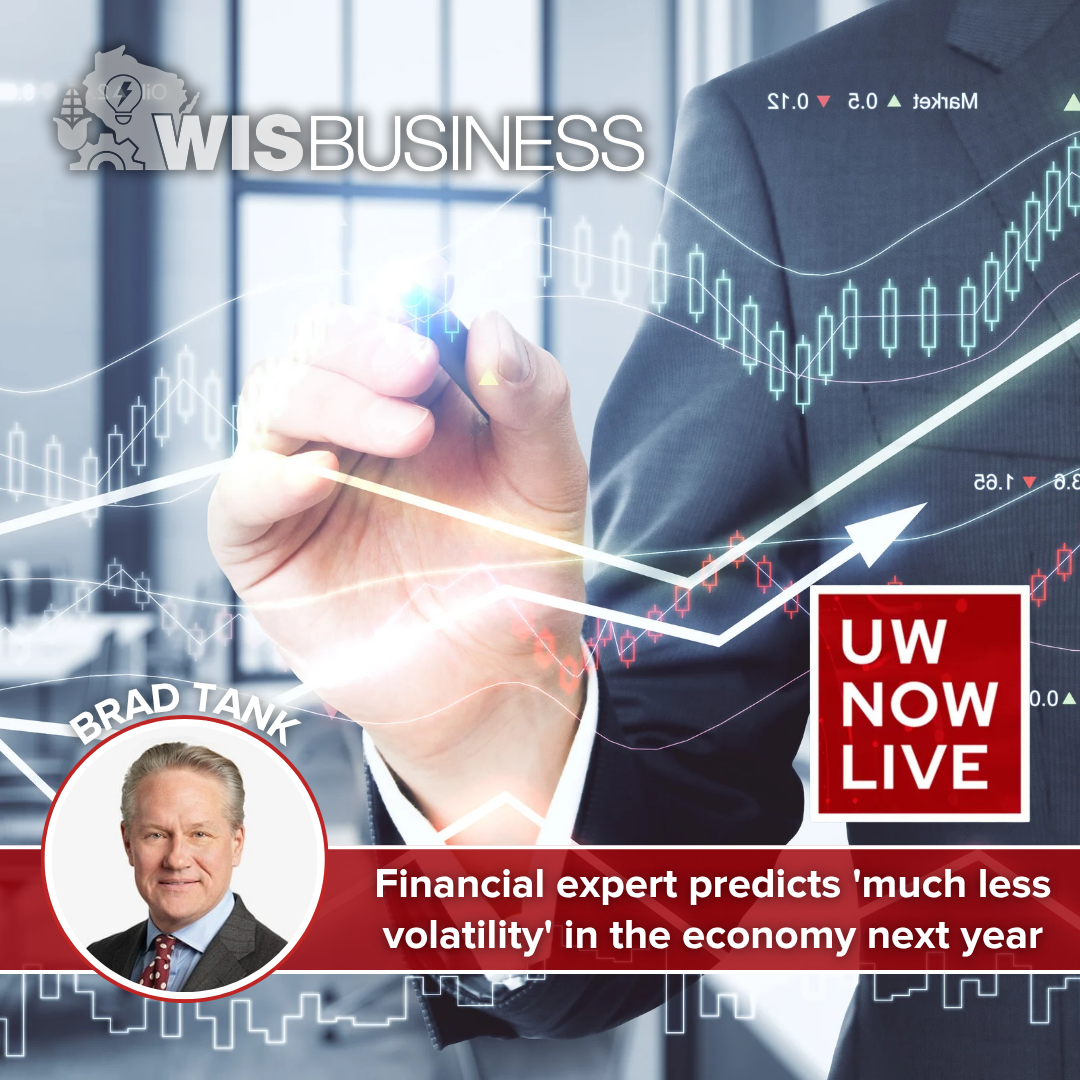
A financial expert predicts “much less volatility” standing in the way of economic growth next year.
Brad Tank, a UW-Madison grad, made the prediction during a recent Wisconsin Alumni Association webinar. He holds a senior advisory role with Neuberger Berman, a New York investment management firm with more than $500 billion in assets under management. During the recent UW Now discussion, he shared insights on this year’s economic trends as well as what’s expected for 2026.
He noted 2025 was a solid year for economic activity with “terrific returns” in the stock market despite the economic uncertainty driven in part by U.S. trade policy.
But Tank said next year’s outlook is even better.
“While we’ve had a lot of policy activity from the current administration, typically, and we would expect this next year, [the] second year of a new administration brings reduced policy volatility and more policy certainty,” he said. “We generally feel that a lot of the noise and impact of the new tariffs regime will be behind us, and we’re looking forward to higher growth.”
Still, he pointed to some lingering uncertainty about tariffs, labor markets and inflation. Tank also noted some of the forecasted impacts of tariffs on inflation “really haven’t materialized” in the market.
“For a variety of reasons, the cost or impact of the tariffs really haven’t been passed through to final prices; we’ve seen a bit of an impact. As we move into next year, the impact should again diminish,” he said, though he added “we’re not returning to the below 2% price inflation that we experienced for a long, long time anytime soon.”
Meanwhile, the labor market has turned out to be weaker than initially estimated, with revisions to national estimates taking away about a million and a half jobs, “which is not insignificant,” Tank said. The more accurate labor market figures show job growth has diminished, he noted, referencing fears about the possible impact of AI.
“It doesn’t seem to be, it’s too early,” he said, pointing instead to ripple effects from businesses in the post-pandemic era “hoarding” labor amid worries about not having enough workers.
“Businesses were very aggressive on the hiring front and they were very cautious on the firing front,” he said. “At the same time, workers were loath to leave their jobs and had less mobility. So labor markets were a bit seized up … I think we’re seeing some relief there.”
Watch the video.