

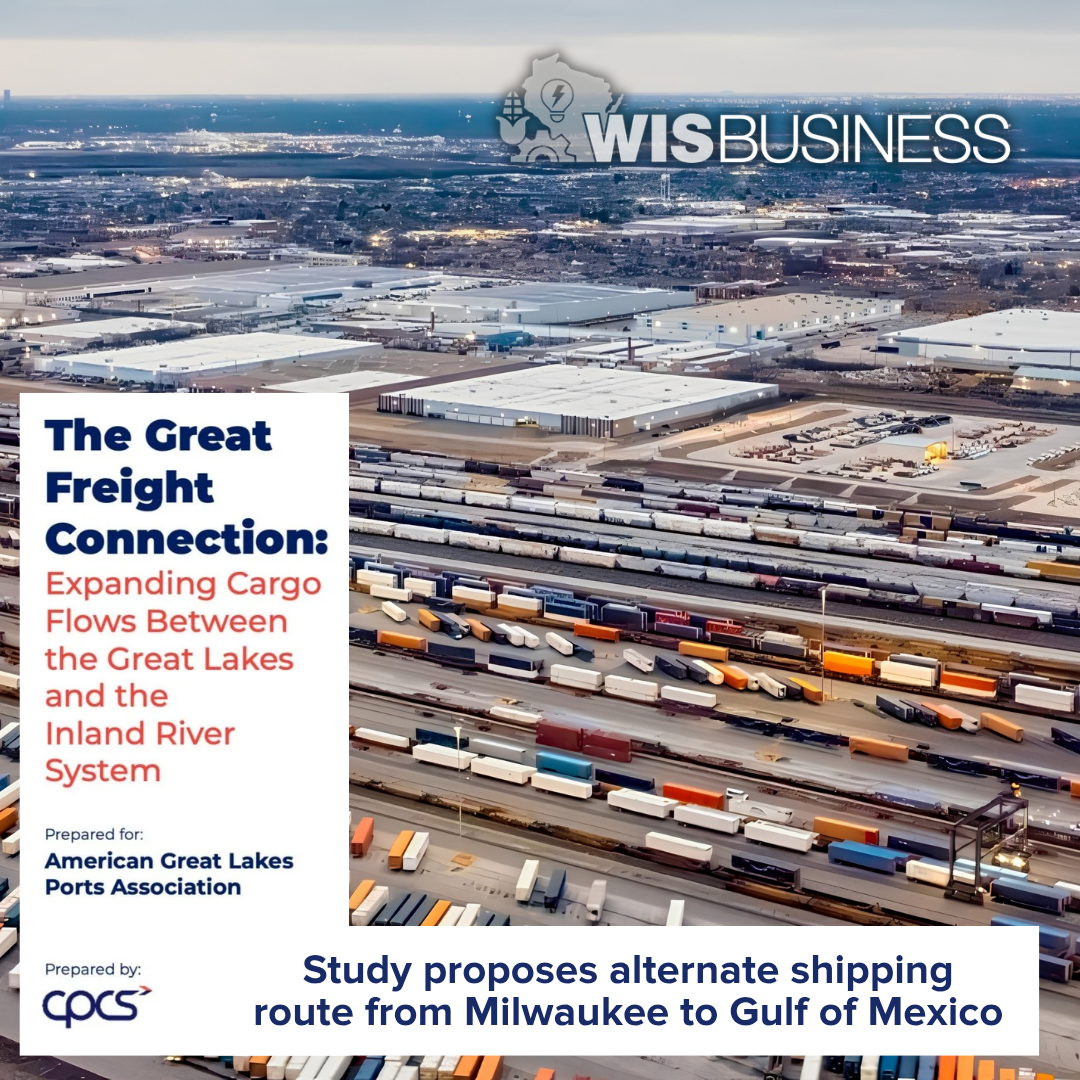
A proposed water-based route for shipping farm goods from Port Milwaukee to the Gulf of Mexico could result in lower costs.
The American Great Lakes Ports Association recently released its Great Freight Connection study, laying out potential alternatives for boosting cargo shipping between Great Lakes ports and inland waterways such as the Mississippi River system.
In one of its four scenarios, grain or other bulk ag goods are shipped south from export terminals in Milwaukee’s port to facilities in the Gulf, where they’d be distributed in the region or loaded onto vessels to be shipped internationally.
It’s posed as an alternative to the more direct rail-based route, using the Illinois River then the Mississippi River for an entirely water-based route. While the water route is much further at 1,472 miles compared to 982 miles by rail, it’s projected to save about $4.50 per ton from the baseline due to barges’ lower cost per ton-mile.
And though the proposed water route wouldn’t necessarily be cheaper in every market condition, authors say its competitiveness would hinge on seasonal trends, equipment availability, how much product is committed, and constraints in the Chicago rail hub.
Still, the proposed route also offers “significant resiliency benefits,” authors wrote.
The study found the all-water path creates a redundant export pathway to the southern Gulf that’s less dependent on water levels in the Upper Mississippi, which it avoids by using a southwest-angling segment of the Illinois River.
In the Upper Mississippi area, low-water conditions mean grain moving through the region “may face delays, draft restrictions, or costly rerouting,” authors wrote.
By using their proposed path, transporters can “help mitigate some of these constraints while also providing modal diversification away from the Chicago-area rail hub, a bottleneck consistently identified by stakeholders,” they wrote.
Meanwhile, the study found rail was slightly more efficient on a per-ton CO2 basis, though both routes for this scenario had “very similar” emissions — 21.2 kilograms of CO2 per ton for the baseline, versus 22.2 kg of CO2 per ton for the all-water route.
Authors note rail is already considered an energy-efficient mode, and the proposed water route’s efficiency is offset by its 50% greater distance. The result is that they’re “roughly neutral” on carbon emissions, with a slight per-ton increase for the proposed water route.
In a statement on the study, Port Milwaukee Director Benjamin Timm touted the opportunity for building on existing shipping connections and finding new ways to serve the companies that use them.
“Our access to both the Great Lakes and inland waterways puts us in a strong position to attract additional cargo and support economic growth across the Upper Midwest,” he said.