
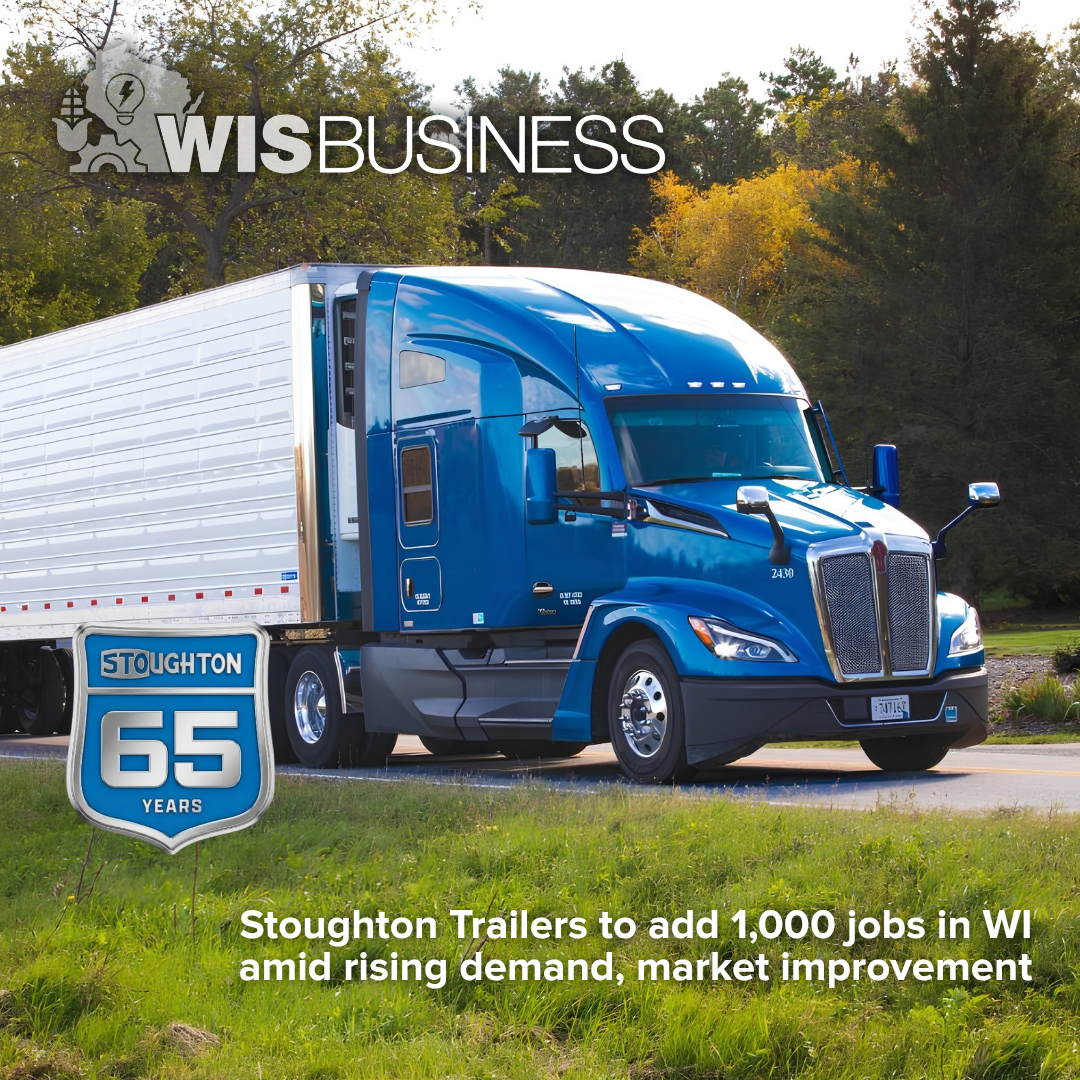
Stoughton Trailers has begun a hiring push that will create 1,000 new jobs in south central Wisconsin as the manufacturer grows to meet rising demand and invests in new technologies.
The company this morning announced the hiring effort, saying it’s added 450 employees since the second quarter of this year and plans to hire about 700 more in 2027. Along with the Wisconsin jobs in Stoughton, Brodhead and Evansville, Stoughton Trailers says it will add 150 positions at its facilities in Waco, Texas.
Jobs being created include engineers, purchasing agents and human resources, but most will be located on the manufacturing floor such as welders, assemblers, and machine operators such as forklift drivers.
That’s according to Bob Wahlin, the company’s president, who says the decision to expand is being driven in part by improvements to the transportation equipment market. In a recent interview, he said freight rates and trucking profitability have both improved recently.
“After several tight years, things are starting to turn around in those areas,” Wahlin said. “The last few years, people have been holding off on purchasing equipment. Now, they’re getting back into their equipment replacement cycles.”
At the same time, the company has gained market share “while things have been slower,” spending more on its plants and equipment, Wahlin said.
Now, he’s looking to capitalize on the improving market landscape as well as recent successful anti-dumping trade efforts, targeting trade practices he said were “choking off supply” and harming the U.S. economy.
“About four months ago, four Chinese companies were indicted by the U.S. Department of Justice, they were container manufacturers … they actually dominated the shipping container industry and chassis industry,” Wahlin said.
Meanwhile, recent investments in advanced manufacturing technologies will help the company do more without needing to expand physically and add more plants, he said. Stoughton Trailers has been adding new AI-assisted robotic welding systems, automated systems for material handling, steel laser-cutting systems, autonomous vehicles and more.
“Massive investments in the efficiency of our plants,” Wahlin said. “So rather than expanding it, adding plants, we’re able to get much more throughput through our existing facilities through the investment in automation and technology.”
As a result, the company has shifted some lower-paying roles to more skilled jobs. Manual welding jobs have been replaced by robotic welding system operators who are paid more, according to Wahlin. Similarly, some human forklift operators have been replaced by self-driving equipment, but the company still needs people to program them and ensure they’re operating properly.
“Although we’re adding people, we don’t have to add nearly as much because of the technology advancements, and the people that we are adding are at a much higher paid level,” Wahlin said, noting that helps amid the broader workforce challenges facing his industry.
The company also operates a temp worker program and brings in workers from Puerto Rico and provides housing for them to live and work in the area.
“So there’s various ways where we can kind of bridge the gap, and it’s kind of an all hands on deck, many different systems to fight through the labor shortage,” he said.
As the hiring effort is underway, the company has also been dealing with some tariff-related cost increases, though Wahlin says he doesn’t expect that to persist. He said the business tries to source most of its components from U.S. producers, aside from what’s not available domestically.
“The demand for things like steel and aluminum definitely has upticked and prices have gone up, just because of some tightness, because of the tariffs,” he said. “But I do think that is short-term, until some of the steel processing plants and aluminum facilities get up online.”
See more in an earlier WisBusiness story on the company.