

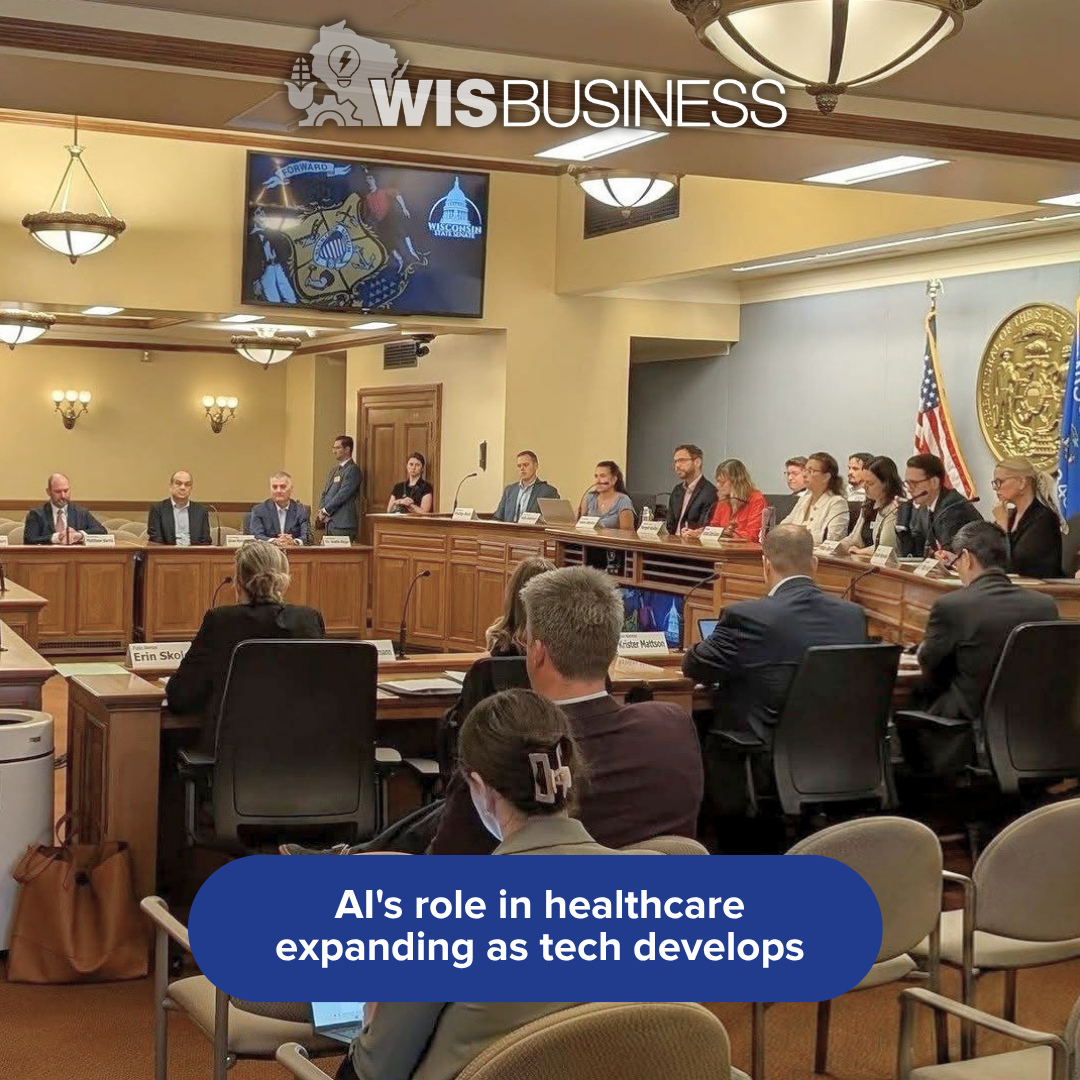
As Wisconsin lawmakers grapple with how to regulate the use of AI in healthcare, tools for both consumers and clinicians are quickly evolving to play a larger, more autonomous role in the medical field.
“There’s many tools out there now,” Frank Meyers of the Federation of State Medical Boards said yesterday during a committee meeting. “Just about a year and a half ago, it was very difficult finding high-level tools from legitimate providers. Now they’re everywhere.”
The meeting of the 2026 Legislative Council Study Committee on the Use of Artificial Intelligence in Health Care featured presentations from industry representatives, regulators, educators and care providers. They discussed how AI is being rapidly adopted in healthcare and what that means for those tasked with keeping it in check.
Meyers, the federation’s director of regulatory innovation and member services, noted Verona’s Epic Systems has built various AI applications into its ubiquitous electronic health records systems.
At the same time, Microsoft’s Dragon Copilot AI platform is built on an ambient scribe tool that was one of the first on the market, he said. The technology listens in on the clinical encounter while documenting and summarizing what happens.
“In the past, that’s really all it did … but those have significantly advanced, to the point where now they are entering information into the medical record itself, they’re being built into automatic prescription renewals so they can pre-load renewals for the clinician’s sign-off,” Meyers said. “Or they’re checking medical contraindications, they’re doing some research surfacing relevant medical journal entries.”
Along with these applications for clinical use, patients too now have more AI options than ever. That includes Amazon’s Health AI program that can read patient records and explain lab results, answer questions about symptoms and route requests to providers. ChatGPT also has a consumer-side health tool for analyzing medical records and related data.
“It’s not meant to provide diagnostic or medical advice, but like with everything with generative AI … if you push it certain ways, you can always kind of get it to respond in certain different ways,” Meyers said.
Meanwhile, Dr. Richard Bruce with UW-Madison’s Department of Radiology yesterday highlighted how AI is supercharging the scientific side of healthcare. He noted the technology is producing “much better” imaging quality based on available data, lower radiation doses and fewer errors — “all things that are slam-dunk home runs from an imaging perspective.”
AI is also being used for real-time quality checks during ultrasounds, automating labelling and even “coaching” technicians on how to get better quality images.
“We get more efficient, higher-quality healthcare as a result of that,” Bruce told the committee.
Still, speakers yesterday cautioned AI tools still aren’t perfect, and their expanded role has led to high-profile mistakes. In one example from just last month, an AI scribe erroneously recorded that the patient had taken psychedelic mushrooms, despite that not being mentioned during the provider visit.
Meyers said this potential “misunderstanding” by the AI system was entered into the patient’s health record, and later surfaced in a letter to her primary care doctor as a possible explanation for her symptoms.
“Watchdog reviewers found this was not an isolated case,” he said. “They have found another scribe had named the wrong breast cancer diagnosis, epilepsy in a patient that had no such epilepsy … a Google bot making up and combining two different body parts to create a whole new body part that didn’t exist.”
As progress and implementation is outstripping regulatory bodies in some cases, certain U.S. states are taking action to protect people’s personal data amid concerns about how much access and power is granted to AI systems.
Jordan Francis, senior policy counsel for the Future of Privacy Forum, yesterday said states are increasingly giving consumers the right to access lists of third parties their information is being sold to, along with new protections around data-based profiling.
“States are also enacting sectoral privacy laws, addressing specific issues like consumer health for data brokers,” Francis said.
Other states are conducting pilots called “sandboxes” allowing companies to roll out AI tools for healthcare within a specified framework. Utah, for example, is waiving certain regulatory requirements from the state’s medical board for this purpose, allowing unlicensed AI-related activity within the scope of the pilot.
Meyers said Utah’s pilot is still ongoing, and initial findings seem promising. But the effort is still in its early days.
“The main takeaway for sandboxes is they’re primarily designed to allow experimentation of these tools, both by the developers but by the regulators to understand what would be the potential best mechanism for regulating these things,” he said.
Six states currently have active sandbox AI pilots — Arizona, Connecticut, Delaware, Kansas, Texas and Utah — while eight others have been proposed, though Meyers noted they differ substantially state-to-state.
“What comes next after the one year? And, you know, the answer is they don’t know,” Meyers said of Utah’s AI policy office. “Nobody really knows.”